
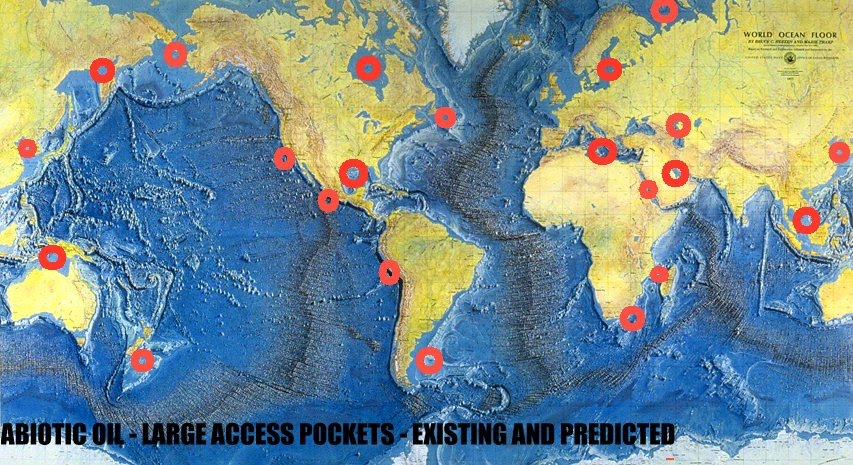
 By Alan David Bergey
My belief is that oil comes not from living organic matter but produced from the primordial earth. It was then locked deep within the earth as the earths crust formed.. This theory comes from Russian scientist in the 1950’s. (Its not a new theory) Below I note the main reasons why the “Fossil fuel” theory should be refuted.
1. There is massive amounts of oil. Every time the industry says “they are running out of oil” they find more. They have been claiming that they are running out of oil for 100 years (with a big scare in the 1970’s) and as time has gone on the have always found more reserves. The oil industry itself has consistently underestimated the oil reserves especially if “recoverable reserves” are considered rather than proven reserves.
How much oil is there? There is a Massive difference between “ known oil in place” and “proven oil reserves”
By definition “Proven oil reserves” are those reserves claimed to have a reasonable certainty (normally at least 90% confidence) of being recoverable under existing economic and political conditions, with existing technology. At present for the whole world this is estimated to be 1.35 Trillion barrels. For the USA this is at present is estimated to be 22 Billion Barrels ( Conventional drilling for oil). For Canadian tar sands it is 173 Billion barrels. Therefore as technology increases or the price increases “known oil in place” ( read below) can become “proven oil reserves”
“ known oil in place” is what geologist estimate is the total amount of oil that is there. For USA, it is 3 Trillion Barrels, if all oil shale’s are included, (1000 times proven reserves). The Bazhenov. field in Western Siberia, in Russia has recently been estimated to be 80 times the size the of the Green river formation in the USA the largest previous known formation. See web article below. (http://www.forbes.com/sites/christopherhelman/2012/06/04/bakken-bazhenov-shale-oil/) For the Canadian tar sands 1.7 – 2 Trillion Barrels, a minimum of 10 times proven reserves. The Venezuelan, government claims a reserve of bitumen even greater than Alberta’s, Estimated total of Canada+ Venezuelan 3 -5.4 Trillion Barrels. .
Map of known tar and oil shale’s on the planet and articles. http://thetyee.ca/News/2010/09/09/OilSandsWorld/ http://thetyee.ca/Opinion/2011/01/14/TarSandsWorldsDirtiest/
2. Initial theory of Fossil oil. When the initial theory of “Fossil oil” appeared around 1890 the scientific community did not know that the primordial earth had a atmosphere consisting of mainly Carbon Dioxide, Methane, Water vapor and Ammonia. Nor did they know that these compounds existed on the gas giants and some of their moons in our solar system. The theory was therefore by default because they could not think of any other place the oil could come from.
3 Russian oil exploitation. There are presently more than 80 oil and gas fields in the Caspian district alone which were explored and developed by applying the perspective of the abiotic theory which produce oil from the crystalline basement rock. (Krayushkin, Chebanenko et al. 1994) Crystalline basement rock forms below sedimentary rock. Clearly the oil could not form above basement rock and then seep through it. Similarly, exploration in the western Siberia cratonic-rift sedimentary basin has developed 90 petroleum fields of which 80 produce either partly or entirely from the crystalline basement.
4 Depth that oil is found. Oil is being found at depths of 30,000 feet. The deepest fossils known are from 16,000 feet. How could oil form from fossils if some oil is 14,000 feet below any of the deepest fossils.
5 Chemical differences of Crude Oil to that in life.
The various elements that make up the cell ( Life) and Crude Oil are:
|
Element |
Weight % in life |
Weight % in oil |
Ratio:
Life / oil |
Element is: |
|
Hydrogen |
10.2 |
14 |
1:1.37 | Concentrated |
|
Oxygen |
66 |
1 |
66:1 | De-concentrated |
|
Carbon |
17.5 |
84 |
1:4.8 | Concentrated |
|
Nitrogen |
2.4 |
1 |
2.2:1 | De- Concentrated |
|
Sulfur |
0.2 |
2 |
10:1 | Concentrated |
|
Phosphorous |
0.9 |
0.00015 |
10000:1 | De- Concentrated |
|
Calcium |
1.5 |
15* ppm |
1000:1 | De- Concentrated |
|
Magnesium |
500ppm |
5* ppm |
100:1 | De- Concentrated |
|
Vanadium |
Trace(1 ppm) |
1200 ppm ** |
1200:1 | Concentrated |
* Maximum found in Pakistani oil fields
** Vanadium is present in fossil fuel deposits such as crude oil, coal, oil shale and tar sands. There is considerable variation in concentration.. In crude oil, concentrations up to 1200 ppm have been reported.
Chemical nature of Crude Oil. Crude oil is mainly hydrocarbons with very little oxygen and consists mainly of the following compounds.
- Paraffin’s, general formula: CnH2n+2 (n is a whole number, usually from 1 to 20) straight- or branched-chain molecules can be gasses or liquids at room temperature depending upon the molecule examples: methane, ethane, propane, butane, iso-butane, pentane, hexane
- Aromatics, general formula: C6H5 – Y (Y is a longer, straight molecule that connects to the benzene ring) ringed structures with one or more rings. Rings contain six carbon atoms, with alternating double and single bonds between the carbons typically liquids examples: benzene, naphthalene
- Napthenes or Cycloalkanes general formula: CnH2n (n is a whole number usually from 1 to 20) ringed structures with one or more rings. Rings contain only single bonds between the carbon atoms typically liquids at room temperature examples: cyclohexane, methyl cyclopentane
- Other hydrocarbons Alkenes general formula: CnH2n (n is a whole number, usually from 1 to 20) linear or branched chain molecules containing one carbon-carbon double-bond can be liquid or gas examples: ethylene, butene, Isobutene Dienes and Alkynes general formula: CnH2n-2 (n is a whole number, usually from 1 to 20) linear or branched chain molecules containing two carbon-carbon double-bonds can be liquid or gas examples: acetylene, butadienes
This nothing like the compounds in life, which tend to be carbohydrates, Cm(H2O)n Polysaccharides(e.g., starch and glycogen), cellulose in plants and chitin in arthropods), amino acids (Some Nitrogen) and fats and fatty acids (Glycerol based). The “oil experts” say the decayed products of life are buried deep underground and cooked under heat and pressure to obtain crude oil. ( OK but I have yet to see validated chemical reaction to produce crude oil under those conditions. )