
 In case you haven’t heard, the world ends tomorrow. Friday 21 December 2012 is the date that the Maya Long Count Calendar reads “thirteen b’aktun”. This has somehow snowballed into a full-blown doomsday prophecy with the apocalypse involving – against all verifiable evidence – black holes, solar flares, previously unknown planets, and comets targeting Earth.
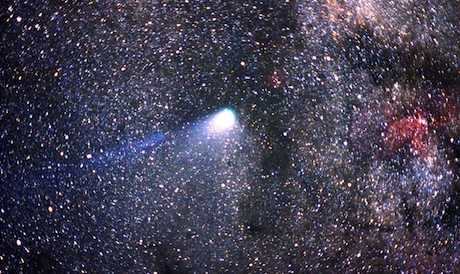
Comets have long been thought harbingers of disaster. As recently as 1910, Halley’s comet was the subject of great public concern. Although it has nothing to do with the present Mayan Apocalypse, the parallels are interesting.
Back then, in an age when telescopes were unable to track the comet around its 76-year orbit, the search for its return was reported by the newspapers. The anticipation of a spectacular view, as a result of the comet’s calculated close passage to Earth, turned to concern when astronomers realised that the Earth would pass through the comet’s 25-million-kilometre-long tail.
Then things got worse. Much worse.
The technique of spectroscopy, in which light is analysed to show the composition of celestial objects, was brought to bear on Halley and on 7 February 1910 the Yerkes Observatory announced the discovery of cyanogen, a deadly poison, in the comet’s tail.
The New York Times reported that the French astronomer and author Camille Flammarion believed that the cyanogen “would impregnate the atmosphere and possibly snuff out all life on the planet.”
In a somewhat misguided attempt to allay fears, the director of the Cambridge Observatory, Sir Robert S Ball, quoted English astronomy doyen Sir John Herschel as saying that the whole comet could be squeezed into a suitcase.
Herschel was probably seeking to emphasise the ephemeral nature of the comet’s gaseous tail, nevertheless it produced a tongue-in-cheek rejoinder in The New York Times that he was clearly talking nonsense because he had failed to state who would do the packing. “Experience teaches that mighty little can be packed in a suitcase by any man. It takes a woman to pack one properly,” said the paper. The light-hearted piece concluded that it would be better to leave the comet where it is in order for everyone to feel safer.
It didn’t work. Concern among the public grew in the weeks leading to the Earth’s 19 May passage through the comet’s tail.
( via guardian.co.uk )