
 By Damon Poeter
PC-Mag
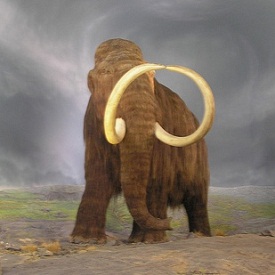
Dr. Ian Malcolm, the chaos theorist played by Jeff Goldblum in Jurassic Park, would surely find this to be a bad idea—Russian and Japanese scientists are planning to clone a woolly mammoth. The research team says it could bringMammuthus primigenius back from extinction within the next five years using marrow cells from a recently discovered mammoth thigh bone and an elephant as a surrogate mother.
At least it’s not a T. Rex, right?
Scientists from Russia’s Siberian Mammoth Museum and Japan’s Kinki University said this week that they are now analyzing what look to be very well-preserved marrow cells from a mammoth’s femur which was discovered in Siberia this August.
Mammoth Musueum acting director Semyon Grigoriev told Discovery News that the team will kick off the ambitious project to enable the birth first live mammoth in 10,000 years beginning in 2012.
Just as Dolly the sheep and other animals have been cloned, the process will involve inserting DNA from the mammoth into the nuclei of naturally occurring egg cells from another animal. Unlike the cloning of existing animals, however, this will mean using the egg cells from an animal of an entirely different species—in this case, one of the three species of elephant, which are in the same taxonomic family as mammoths, known as Elephantidae.
If successful, an elephant surrogate mother would be impregnated with the resulting zygote, hopefully bringing it to term.
But the mammoth team faces long odds in their pursuit, according to scientists at the Roslin Institute where Dolly was cloned in 1996. They said the chances of successfully cloning an extinct species was in the range of 1 to 5 percent, according to the BBC, and suggested a cow would actually be the “best biological fit” as a surrogate mother, though that would likely mean gestation to term would not be possible.
But another scientist, Charles Foster of Oxford’s Green Templeton College, told the news agency that cloning a mammoth “isn’t completely ridiculous.” But he added that if successful, the resulting animal would have to be considered a hybrid rather than a pure mammoth because some of its genetic coding would come from the elephant ovum into which the mammoth nuclei was inserted.
If the team is successful, it wouldn’t actually be the first time an extinct animal has been restored through cloning. In 2009, Spanish scientists managed to clone a bucardo, or Pyrenean ibex, using a domestic goat egg and an ibex-goat hybrid as a surrogate mother.
But the bucardo clone died just minutes after its birth—and that was an animal that only went extinct in 2000.