
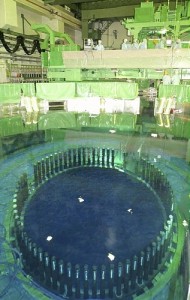
 After visiting Fukushima, Senator Ron Wyden warned that the situation was worse than reported, Washington’s Blog reports … and urged Japan to accept international help to stabilize dangerous spent fuel pools.
Wyden said that the spent fuel is a national security threat to the U.S.: “The radiation caused by the failure of the spent fuel pools in the event of another earthquake could reach the West Coast within days. That absolutely makes the safe containment and protection of this spent fuel a security issue for the United States.”
MSNBC video: Senator calls for U.S. help in Fukushima cleanup:
An international coalition of nuclear scientists and non-profit groups are calling on the U.N. to coordinate a multi-national effort to stabilize the fuel pools. If Fukushima Unit 4 falls, hazardous radioactive Cesium-137 release could be eight times worse than Chernobyl, warned Kevin Kamps, radioactive waste specialist at Beyond Nuclear.
Fuel pool number 4 is, indeed, the top short-term threat facing humanity, according to some experts.
Anti-nuclear physician Dr. Helen Caldicott says that if fuel pool 4 collapses, she will evacuate her family from Bostonand move them to the Southern Hemisphere. This is an especially dramatic statement given that the West Coast is much more directly in the path of Fukushima radiation than the East Coast.
And on April 15, nuclear expert Arnie Gundersen said in a KGO radio interview (at 25:00): “There’s more cesium in that [Unit 4] fuel pool than in all 800 nuclear bombs exploded above ground…But of course it would happen all at once. It would certainly destroy Japan as a functioning country. Move south of the equator if that ever happened, I think that’s probably the lesson there.”
Yet Tepco’s current plans are to hold the majority of this spent fuel on-site for years in the same elevated, un-contained storage pools, only transferring some of the fuel into more secure, hardened dry casks when the common pool reaches capacity.
Government agencies underplaying risk
Why are American nuclear authorities ignoring this threat? “Nuclear waste experts … charge that the NRC is letting this threat [of the Fukushima fuel pools] fester because acknowledging it would call into question safety at dozens of identically designed nuclear power plants around the U.S., which contain exceedingly higher volumes of spent fuel in similar elevated pools outside of reinforced containment,” according to AlterNet, and American nuclear power plants are storing much more nuclear fuel rods in highly-vulnerable pools than even Fukushima.
The NRC and Japanese claim that fuel pool 4 has been stabilized, but nuclear experts, including Arnie Gundersen, a former nuclear industry senior vice president who coordinated projects at 70 U.S. nuclear power plants, and warned days after the disaster at Fukushima last year of a “Chernobyl on steroids” if the spent fuel pools were to ignite, strongly disagreed with this assessment.
“It is true that in May and June the floor of the U4 SFP [spent fuel pool] was ‘reinforced,’ but not as strong as it was originally,” Gundersen noted in an email to AlterNet. “The entire building however has not been reinforced and is damaged by the explosion in both 4 and 3. So structurally U4 is not as strong as its original design required.”
Robert Alvarez, a nuclear expert and a former special assistant to the United States Secretary of Energy, said that even if the unit 4 structure has been tentatively stabilized, it doesn’t change the fact “it sits in a structurally damaged building, is about 100 feet above the ground and is exposed to the atmosphere, in a high-consequence earthquake zone.”