
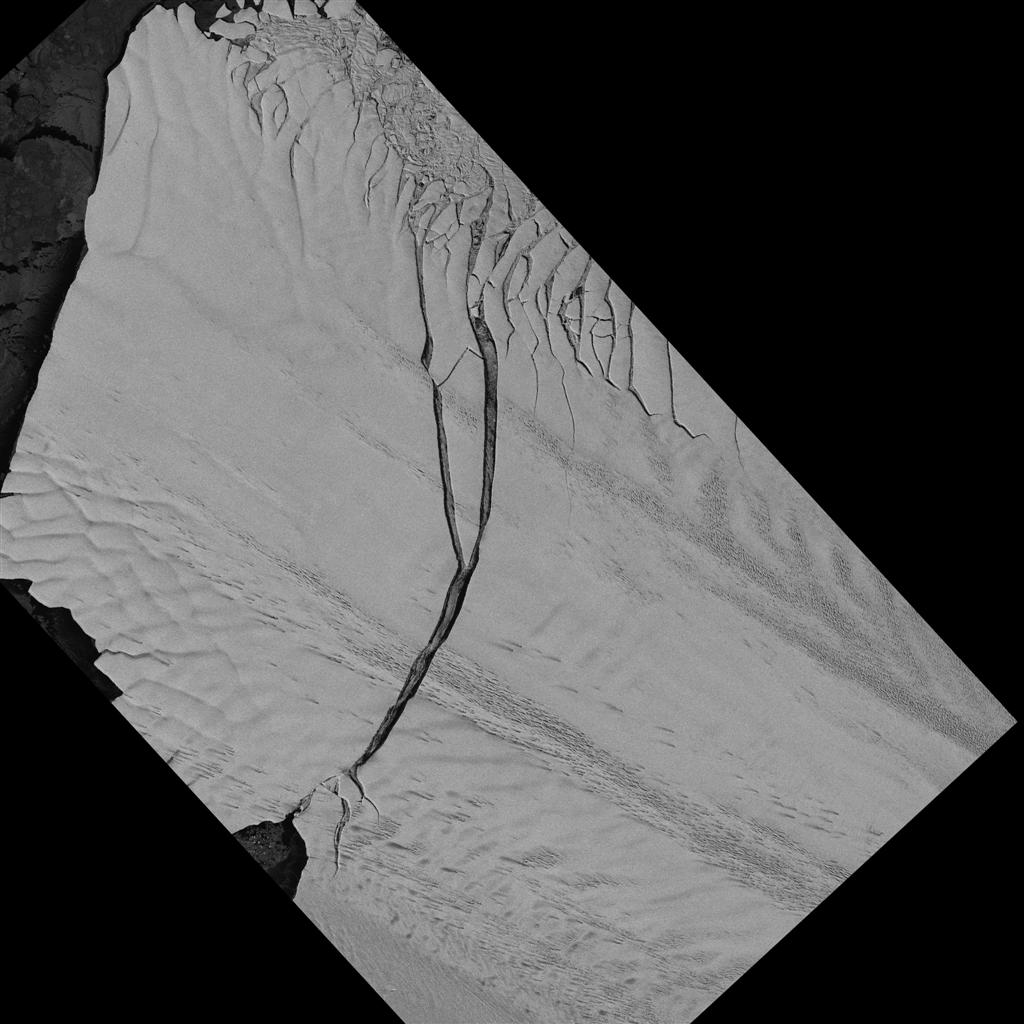
 A huge area of the ice shelf broke away from the Pine Island glacier, the longest and fastest flowing glacier in the Antarctic, and is now floating in the Amundsen Sea in the form of a very large iceberg. Scientists of the Alfred Wegener Institute, Helmholtz Centre for Polar and Marine Research have been following this natural spectacle via the earth observation satellites TerraSAR-X from the German Space Agency (DLR) and have documented it in many individual images.
Scientists from the American space agency NASA discovered the first crack in the glacier tongue on 14 October 2011 when flying over the area. At that time it was some 24 kilometres long and 50 metres wide. ”As a result of these cracks, one giant iceberg broke away from the glacier tongue. It measures 720 square kilometres and is therefore almost as large as the city of Hamburg“, reports Prof. Angelika Humbert, ice researcher at the Alfred Wegener Institute.
”Above the large crack, the glacier last flowed at a speed of twelve metres per day“, reports Humbert’s colleague Dr. Dana Floricioiu from DLR. And Nina Wilkens, PhD graduate in Prof. Humbert’s team, adds: “Using the images we have been able to follow how the larger crack on the Pine Island glacier extended initially to a length of 28 kilometres. Shortly before the “birth” of the iceberg, the gap then widened bit by bit so that it measured around 540 metres at its widest point.“
Are ice breaks caused by climate change? Angelika Humbert does not so far see any direct connection: “The creation of cracks in the shelf ice and the development of new icebergs are natural processes“, says the glaciologist. However, the Pine Island glacier, which flows from the Hudson mountains to the Amundsen Sea, was the fastest flowing glacier in the Western Antarctic with a flow speed of around 4 kilometres per yeaar.
For the Western Antarctic ice shelf, an even faster flow of the Pine Island glacier would presumably have serious consequences. “The Western Antarctic land ice is on land which is deeper than sea level. Its “bed” tends towards the land. The danger therefore exists that these large ice masses will become unstable and will start to slide“, says Angelika Humbert. If the entire West Antarctic ice shield were to flow into the Ocean, this would lead to a global rise in sea level of around 3.3 metres.