
By Marcia Stone
Decoded Science
You may want to put down that fork – brain-damaging prions could be lurking in your dinner.
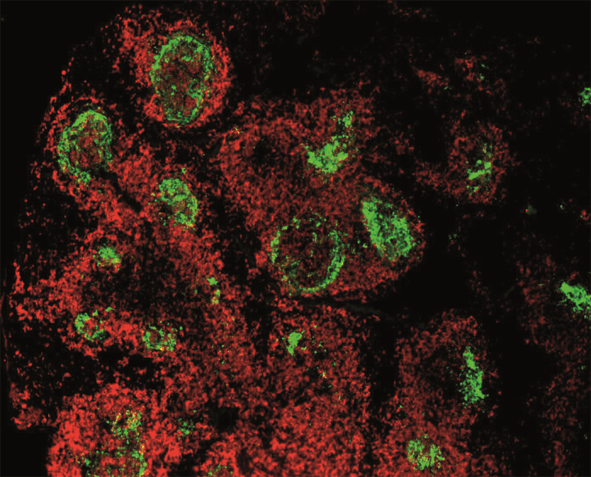
By showing that spleen tissue is up to sevenfold more receptive to foreign prions than that of the brain, Vincent Béringue PhD, and colleagues at the Institut National de la Recherche Agronomique (INRA) in Jouy-en-Josas, France, recently challenged the long-held notion of absolute species barriers. What this suggests is that testing brain tissue, rather than lymphatic tissue, of animals destined for the dinner table is very misleading. Furthermore, say these scientists, most prion disease will likely remain silent for the lifetimes of the hosts, making infection very difficult to spot.
Why is this so worrying? Prions (short for “proteinaceous infectious agents”) are a well-documented cause of “mad cow disease,” or bovine spongiform encephalopathy (BSE), as well as “scrapie” in sheep, chronic wasting disease (CWD) in deer and elk, and Creutzfeldt-Jakob disease (CJD) in humans. Prions are also currently a protein-of-interest in the genesis of Alzheimer’s disease, so the Béringue team’s findings have significant public health implications.
Species-Jumping Prions Propagate Silently in Lymphoid Tissue With no Detectable Signs of Brain Disease
Four experiments in two different mouse models were used to test the efficiency of tissue-dependent cross-species prion transmission of several types of prions, including the BSE strain that causes variant Creutzfeldt-Jakob disease (vCJD) in humans and CWD, another prion of great concern to public health officials.
In the first experiment, the French team inoculated transgenic “ovinized” mice, or mice which express normal sheep prion protein (PrP) genes, with pathogenic prions (PrPres) that cause CWD in deer. Researchers found CWD prions in only 2 of the 29 mouse brains at the end of life –between 507 and 793 days. “In marked contrast, significant levels of CWD prions were detected in the spleens of all but one of the 18 mice tested from approximately 380 days onward,” Béringue told this writer. Despite the fact that almost all had infected spleens, none of the mice showed evidence of clinical disease, which raised new concerns about the extent of silent prion disease in the human population.
To make certain that prions hadn’t slipped by undetected, a second passage was done in disease-free ovinized mice with either CWD-positive brain or spleen material from an asymptomatic mouse inoculated with CWD-prions. None of the mice that were injected with brain material evidenced neurologic symptoms, or accumulated pathogenic prions by the end of life, which indicated that the inoculated brain tissue was PrPres free. However, the mice receiving spleen material accumulated pathogenic protein in both brain and spleen – yet all appeared healthy.