
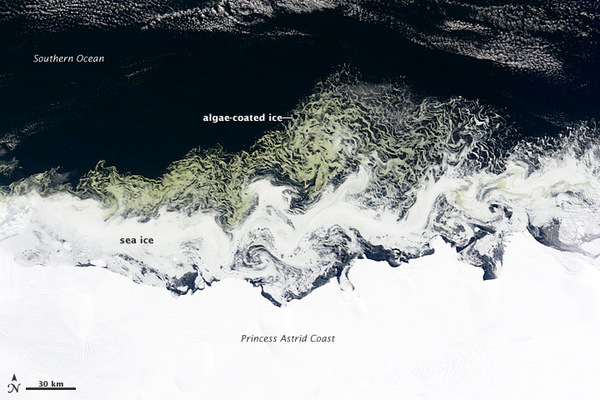
Late last month, a NASA satellite flying over East Antarctica spotted swirls of green off the Princess Astrid Coast that left experts wondering just what it was.
Such a pattern usually indicates a bloom of tiny plantlike organisms called phytoplankton, which form thebase of the ocean food chain. Such blooms are common along the Antarctic coast, but typically form in early December, in the austral spring, not so late in the summer season, according to experts consulted by NASA.
“It doesn’t look like a phytoplankton bloom to me,” Stanford University marine biologist Kevin Arrigo, who led NASA’s ICESCAPE expeditions to the Arctic in 2010 and 2011, told NASA. “The spatial pattern resembles the sea ice too closely. It looks suspiciously like green sea ice. Plus, it’s very late for such a bloom in the Antarctic.”
Green sea ice is green because algae forms on top of it.
Scientists with the Antarctic Climate and Ecosystems Cooperative Research Center in Australia had seen the picture, taken by the Moderate Resolution Imaging Spectroradiometer (MODIS) instrument aboard the Terra satellite, and thought it could indeed be a phytoplankton bloom, if an unseasonal one.
“I witnessed this bloom in East Antarctica at about the same time. The largest single patch was in the Cape Darnley region, between the Amery Ice Shelf and Mawson Station. I have also seen smaller blooms to the west of the West Ice Shelf and off the Mertz Glacier region in recent weeks. Blooms are not unusual in Antarctica and have been reported before, but usually at a different time of year (early December),” Jan Lieser, a scientist with the group, told NASA spokespeople in an email.
The uncertainty in the positive identification of the green swirls shows that there are still limited to what satellites can tell us about what is happening in remote regions, according to a NASA statement, and that sometimes, scientists have to investigate in person.
Luckily, Lieser’s colleagues aboard the vessel Aurora Australis were in a position to do just that. The ship was on its way back from Mawson Station, one of three permanent Australian bases in the Australian Antarctic Territory of East Antarctica, to Hobart, Tasmania, and was able to stop by the area of the swirls and take samples.
“Reports from the ship as it was sampling and traversing through the bloom indicate that the region was covered by small pancakes of sea ice with algae visible on the sides and undersides, apparently floating in a sea of greenish brown,” Lieser said.
The samples are due back in Hobart later this month, and will help scientists learn more about the swirls, including identifying the algae’s species.