
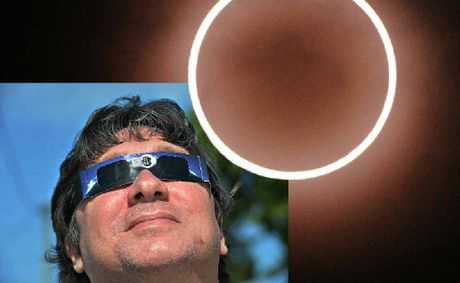
People from around the world are converging on the coast of northeast Australia.
The attraction isn’t the Great Barrier Reef, just offshore, or the surrounding rain forests full of wildlife and exotic plants. They’re going to see a total eclipse of the sun. On the morning of Nov. 14th (Australia time), about an hour after sunrise, the Moon will pass directly in front of the sun. Residents and visitors of the city of Cairns, also known as the Gateway to the Great Barrier Reef, will enjoy an early morning eclipse lasting 2 minutes with the sun only 14 degrees above the eastern horizon. NASA eclipse expert Fred Espenak has a rating scheme for natural wonders.
“On a scale of 1 to 10,” he says, “total eclipses are a million.” Even the reef itself will be momentarily forgotten by onlookers as the Moon’s cool shadow sweeps across the beach and the ghostly tendrils of the solar corona surround the black lunar disk. But there’s more to this event than tourism. Scientists are attending, too.
For researchers, the brief minutes of totality offer a window into one of the deepest mysteries of solar physics: The mystery of coronal heating. In plain language, they’d like to know why the sun’s outer atmosphere or “corona” is so hot. The surface temperature of the sun is only 6000 degrees C. Yet the corona above it is much warmer, a million degrees Celsius or even more. To understand the physics involved, astronomers have developed instruments called coronagraphs, which block the glare of the sun to reveal the faint corona.
Three spacecraft, SOHO and the twin STEREO probes, currently monitor the solar corona using these devices. But no manmade instrument can match Earth’s natural satellite. The Moon is nature’s greatest coronagraph. During an eclipse, “the moon reveals the innermost corona, which manmade coronagraphs have trouble seeing,” explains Shadia Habbal of the Institute for Astronomy in Hawaii. “That is where all the magnetic field and physical processes responsible for heating the corona are evolving most rapidly.”