
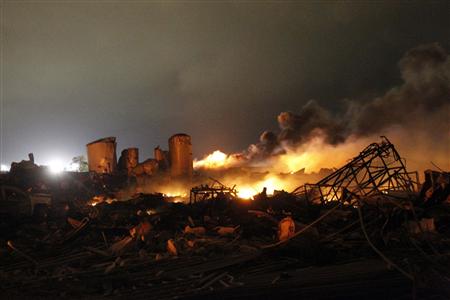
The Texas fertilizer plant that exploded two weeks ago, killing 14 people and injuring about 200, was a repeat target of theft by intruders who tampered with tanks and caused the release of toxic chemicals, police records reviewed by Reuters show.
Police responded to at least 11 reports of burglaries and five separate ammonia leaks at West Fertilizer Co over the past 12 years, according to 911 dispatch logs and criminal offense reports Reuters obtained from the McLennan County Sheriff’s office in Waco, Texas through an Open Records Request.
Some of the leaks, including one reported in October 2012, were linked to theft or interference with tank valves.
According to one 2002 crime report, a plant manager told police that intruders were stealing four to five gallons of anhydrous ammonia every three days. The liquid gas can be used to cook methamphetamine, the addictive and illicit stimulant.
In rural areas across the United States, the thriving meth trade has turned storage facilities like West Fertilizer Co and even unattended tanks in farm fields into frequent targets of theft, according to several government and fertilizer industry reports issued over the past 13 years.
The cause of the April 17 blast at the plant in the town of West is still being probed, and investigators have offered no evidence that security breaches contributed to the deadly incident. There also is no indication that the explosion had anything to do with the theft of materials for drug making. Anhydrous ammonia has been ruled out as a cause because the four storage tanks remained intact after the blast, said Rachel Moreno, a spokeswoman for the Texas Fire Marshal’s Office.
Investigators are pursuing about 100 leads, including a call to an arson hotline and a tip that there had been a fire on the property earlier on the day of the explosion, according to Moreno. Authorities have not said whether either tip was credible. About 80 investigators from various state and federal agencies are contributing to the probe. They hope to determine by May 10 what caused the explosion, Texas Fire Marshal Chris Connealy said at a state legislative hearing on Wednesday.
A spokesman for the U.S. Department of Homeland Security (DHS), one of several state and federal agencies that monitor security at chemical plants, declined to answer questions about the breaches of security at West Fertilizer Co. State investigators also declined to comment.
Thefts of anhydrous ammonia are common in McLennan County, where burglars siphon fertilizer from trailer tanks into five-gallon propane containers, said McLennan County Chief Deputy Sheriff Matt Cawthon, who took up the position in January.
After reviewing crime reports from the past 12 years and speaking to deputies who responded to some of the break-ins, Cawthon said security was clearly lax at the plant.
The perimeter was not fenced, and the facility had no burglar alarms or security guards, he said. “It was a hometown-like situation. Everybody trusts everybody.”
Chemical safety experts said the recurrent security breaches at West Fertilizer are troubling because they suggest vulnerability to theft, leaks, fires or explosions. Apart from anhydrous ammonia, the company stored tons of ammonium nitrate, a fertilizer that can be used in bomb-making. No thefts of that substance were reported to police.
“Regardless of what triggered this specific event, the fact that there were lots of burglaries and that they were after ammonia clearly shows this plant was vulnerable to unwanted intruders or even a terrorist attack,” said Sam Mannan, a chemical process safety expert at Texas A&M University, who has advised Dow Chemical and others on chemical security.