
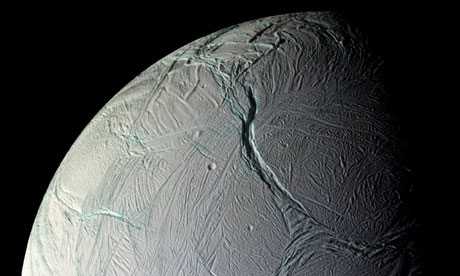
 Enceladus is little bigger than a lump of rock and has appeared, until recently, as a mere pinprick of light in astronomers’ telescopes. Yet Saturn’s tiny moon has suddenly become a major attraction for scientists. Many now believe it offers the best hope we have of discovering life on another world inside our solar system.
The idea that a moon a mere 310 miles in diameter, orbiting in deep, cold space, 1bn miles from the sun, could provide a home for alien lifeforms may seem extraordinary. Nevertheless, a growing number of researchers consider this is a real prospect and argue that Enceladus should be rated a top priority for future space missions.
This point is endorsed by astrobiologist Professor Charles Cockell of Edinburgh University. “If someone gave me several billion dollars to build whatever space probe I wanted, I would have no hesitation,” he says. “I would construct one that could fly to Saturn and collect samples from Enceladus. I would go there rather than Mars or the icy moons of Jupiter, such as Europa, despite encouraging signs that they could support life. Primitive, bacteria-like lifeforms may indeed exist on these worlds but they are probably buried deep below their surfaces and will be difficult to access. On Enceladus, if there are lifeforms, they will be easy to pick up. They will be pouring into space.”
The cause of this unexpected interest in Enceladus – first observed by William Herschel in 1789 and named after one of the children of the Earth goddess Gaia – stems from a discovery made by the robot spacecraft Cassini, which has been in orbit of Saturn for the past eight years. The $3bn probe has shown that the little moon not only has an atmosphere, but that geysers of water are erupting from its surface into space. Even more astonishing has been its most recent discovery, which has shown that these geysers contain complex organic compounds, including propane, ethane, and acetylene.
Cassini’s observations suggest Enceladus possesses a subterranean ocean that is kept liquid by the moon’s internal heat. “We are not sure where that energy is coming from,” McKay admits. “The source is producing around 16 gigawatts of power and looks very like the geothermal energy sources we have on Earth – like the deep vents we see in our ocean beds and which bubble up hot gases.”
At the moon’s south pole, Enceladus’s underground ocean appears to rise close to the surface. At a few sites, cracks have developed and water is bubbling to the surface before being vented into space, along with complex organic chemicals that also appear to have built up in its sea.
( via guardian.co.uk)