
 By Pallab Ghosh
BBC News
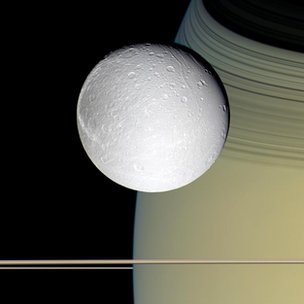
A Nasa spacecraft has detected oxygen around one of Saturn’s icy moons, Dione.
The discovery supports a theory that suggests all of the moons near Saturn and Jupiter might have oxygen around them.
Researchers say that their finding increases the likelihood of finding the ingredients for life on one of the moons orbiting gas giants.
The study has been published in Geophysical Research Letters.
According to co-author Andrew Coates of University College London, Dione has no liquid water and so does not have the conditions to support life. But it is possible that other moons of Jupiter and Saturn do.
“Some of the other moons have liquid oceans and so it is worth looking more closely at them for signs of life,” Prof Coates said.
The discovery was made using the Cassini spacecraft, which flew by Dione nearly two years ago. Instruments on board the unmanned probe detected a thin layer of oxygen around the moon, so thin that scientists prefer to call it an “exosphere” rather than an atmosphere.
But the discovery is important because it suggests there is a process at work around the solar system’s gas giants, Saturn and Jupiter, in which oxygen is released from their icy satellites.
It seems that highly charged particles from the planets’ powerful radiation belts split the water in the ice into hydrogen and oxygen.
Dione’s sister moon, Enceladus is thought to harbour a liquid ocean below its icy surface. The same is thought to be true of Europa, Callisto and Ganymede which orbit Jupiter.
Prof Coates is among a group of scientists lobbying the European Space Agency to send an orbiter to explore Jupiter’s icy moons – known as the Juice mission.
“These are fascinating places to look for signs of life,” he said.
As is Titan, Saturn’s largest satellite. Its nitrogen and methane atmosphere is reminiscent of the early Earth, according to Prof Coates.
“It may be an Earth waiting to happen as the outer Solar System warms up,” he said.
Nasa is developing a proposal to send a landing craft, or lander, to float on one of the planet’s oily lakes.