
A team of paleontologists has discovered the oldest animal with a skeleton. Called Coronacollina acula, the organism is between 560 million and 550 million years old, which places it in the Ediacaran period, before the explosion of life and diversification of organisms took place on Earth in the Cambrian.
The finding provides insight into the evolution of life — particularly, early life — on the planet, why animals go extinct, and how organisms respond to environmental changes. The discovery also can help scientists recognize life elsewhere in the universe.
The Ediacaran Period, named after the Ediacara Hills of South Australia, ranges 630-542 million years ago. The Cambrian Period, marked by a rapid diversification of life-forms on Earth as well as the rise of mineralized organisms, ranges 542-488 million years ago.
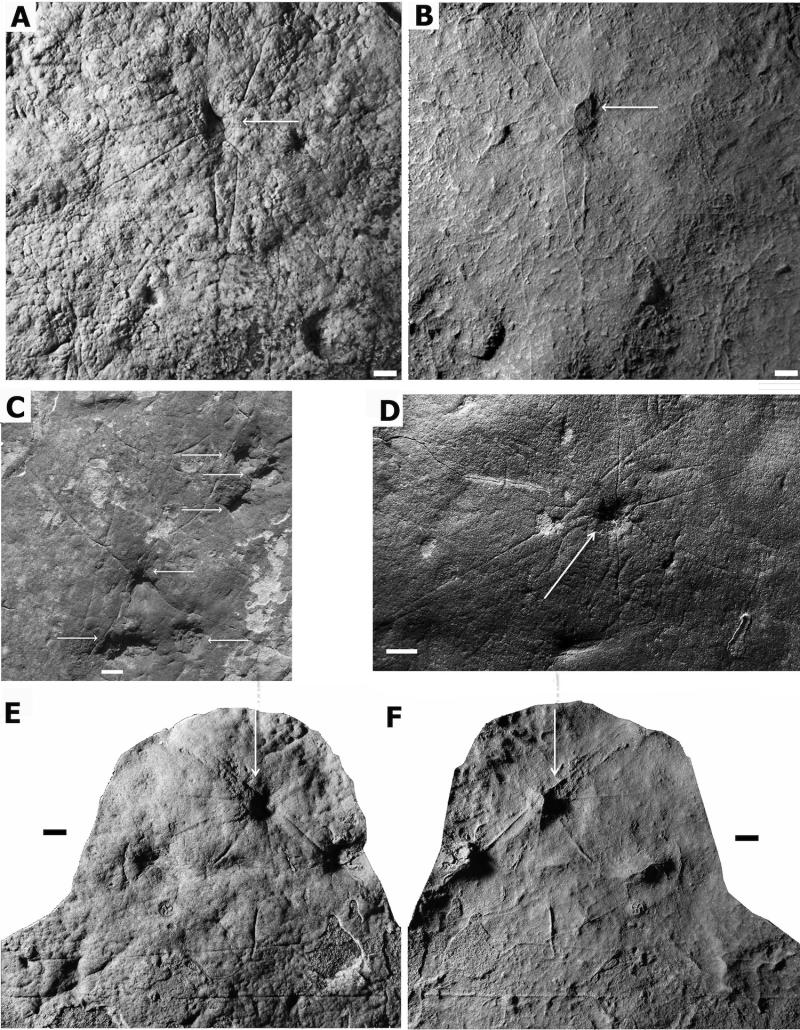
The best Coronacollina specimens showing the main body with articulated spicules. Specimens originate from different field localities. Arrows indicate main body of Coronacollina. White/black bars indicate 1 cm. A, C, D and E are photographs of fossil impressions in the rock. B and F are latex casts showing how the fossils would have looked in life, after compression. Image credit: Droser lab, UC Riverside.
“Up until the Cambrian, it was understood that animals were soft bodied and had no hard parts,” said Mary Droser, a professor of geology at the University of California, Riverside, whose research team made the discovery in South Australia. “But we now have an organism with individual skeletal body parts that appears before the Cambrian. It is therefore the oldest animal with hard parts, and it has a number of them — they would have been structural supports — essentially holding it up. This is a major innovation for animals.”
Coronacollina acula is seen in the fossils as a depression measuring a few millimeters to 2 centimeters deep. But because rocks compact over time, the organism could have been bigger — 3 to 5 centimeters tall. Notably, it is constructed in the same way that Cambrian sponges were constructed.
“It therefore provides a link between the two time intervals,” Droser said. “We’re calling it the ‘harbinger of Cambrian constructional morphology,’ which is to say it’s a precursor of organisms seen in the Cambrian. This is tremendously exciting because it is the first appearance of one of the major novelties of animal evolution.”
According to Droser, the appearance of Coronacollina acula signals that the initiation of skeletons was not as sudden in the Cambrian as was thought, and that Ediacaran animals like it are part of the evolutionary lineage of animals as we know them.
“The fate of the earliest Ediacaran animals has been a subject of debate, with many suggesting that they all went extinct just before the Cambrian,” she said. “Our discovery shows that they did not.”
Study results appeared online Feb. 14 in Geology.
The researchers note that Coronacollina acula lived on the seafloor. Shaped like a thimble to which at least four 20-40-centimeter-long needle-like “spicules” were attached, Coronacollina acula most likely held itself up by the spicules. The researchers believe it ingested food in the same manner a sponge does, and that it was incapable of locomotion. How it reproduced remains a mystery.