
 By Denise Chow
Live-Science
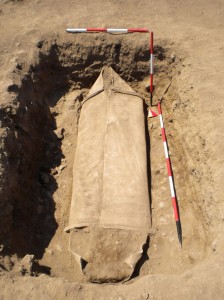
Archaeologists found a 1,000-pound lead coffin while digging in the ruins of an ancient city near Rome last summer. The mission now is to determine who or what is buried inside.
The project – which is headed by Nicola Terrenato, a professor of classical studies at the University of Michigan – is the largest American-led dig in Italy in the past 50 years.
“We’re very excited about this find,” Terrenato said. “Romans as a rule were not buried in coffins to begin with and when they did use coffins, they were mostly wooden. There are only a handful of other examples from Italy of lead coffins from this age – the second, third or fourth century A.D. We know of virtually no others in this region.”
This coffin is of particular interest to Terrenato and his team of archaeologists due to its size. “It’s a sheet of lead folded onto itself an inch thick,” Terrenato said. “A thousand pounds of metal is an enormous amount of wealth in this era. To waste so much of it in a burial is pretty unusual.”
The coffin is set to be transported to the American Academy in Rome, where engineers will closely examine the bones and any symbols or gifts left in the coffin in order to determine who is buried inside.
Lead coffins tend to keep human remains well-preserved. In fact, an ancient Greek mummy of a middle-aged woman was discovered in a lead coffin and reported a couple years ago.
For the new finding, the researchers want to avoid breaking into the coffin, which could damage the contents. Instead, the team plans to use less invasive techniques, such as thermography and endoscopy (essentially tiny cameras) to examine the sarcophagus.
The process of thermography involves heating the coffin slowly and recording the thermal responses of the various contents. Bones would have different thermal responses than other artifacts that could be inside, Terrenato said. The researchers would then turn to endoscopy, which involves inserting tiny cameras inside the coffin. Still, the effectiveness of endoscopy is contingent on how much dirt has built up inside the coffin over the centuries.
If these techniques fail, researchers could perform an MRI scan on the container, but this option is expensive and would involve transporting the half-ton coffin to a hospital.
The dig that unearthed this mysterious casket began in the summer of 2009 and will continue through 2013. Approximately 75 researchers from across the U.S., including a dozen undergraduate students from the University of Michigan, spend two months working on the project on location in the ruins of the ancient city of Gabii (pronounced “gabby”).