
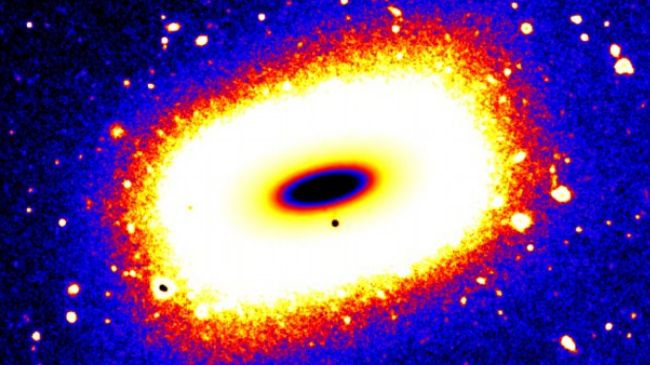
 Astronomers have found a rectangular galaxy in a wide field-of-view image taken with the Japanese Subaru Telescope for Swinburne astrophysicist Dr. Lee Spitler.
The unusual cosmic phenomenon was discovered 70 million light years away within a group of 250 galaxies.
“In the Universe around us, most galaxies exist in one of three forms – spheroidal, disc-like, or lumpy and irregular in appearance,” said Associate Professor Alister Graham from Swinburne University of Technology in Australia.
“It’s one of those things that just makes you smile because it shouldn’t exist, or rather you don’t expect it to exist,” he added.
“It’s a little like the precarious Leaning Tower of Pisa or the discovery of some exotic new species which at first glance appears to defy the laws of nature.”
Astronomers say the galaxy is not actually rectangular in shape and might look like an inflated disc seen side on, like a short cylinder.
The Keck Telescope in Hawaii supported the idea revealing a rapidly spinning, thin disc with a side-on orientation lurking at the center of the galaxy.
“One possibility is that the galaxy may have formed out of the collision of two spiral galaxies,” said Swinburne Professor and co author of the research Duncan Forbes.
“While the pre-existing stars from the initial galaxies were strewn to large orbits creating the emerald cut shape, the gas sank to the mid plane where it condensed to form new stars and the disc that we have observed.”
The newly-found galaxy can provide astronomers with useful information for modeling other galaxies.
“This highlights the importance of combining lessons learned from both types of past simulation for better understanding galaxy evolution in the future,” said Associate Professor Graham.
“One of the reasons this emerald cut galaxy was hard to find is due to its dwarf-like status – it has 50 times less stars than our own Milky Way galaxy, plus its distance from us is equivalent to that spanned by 700 Milky Way galaxies placed end-to-end.
“Curiously, if the orientation was just right, when our own disc-shaped galaxy collides with the disc-shaped Andromeda galaxy about three billion years from now we may find ourselves the inhabitants of a square-looking galaxy.”