
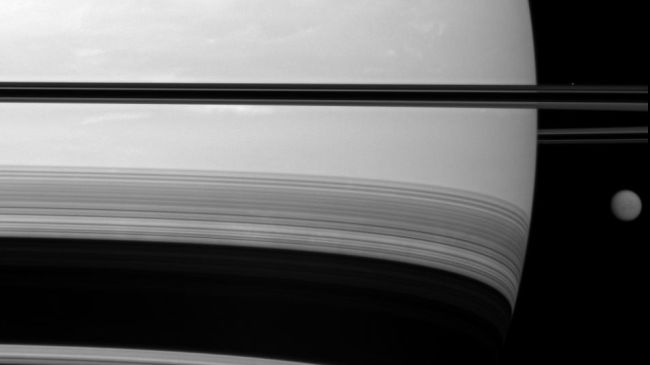
 Scientists have discovered methane lakes in the tropical areas of Saturn’s moon Titan, one of which is about half the size of Utah’s Great Salt Lake, with a depth of at least one meter.
The longstanding bodies of liquid were detected by NASA’s Cassini spacecraft, which has been orbiting Saturn since its arrival at the ringed planet in 2004.
It was previously believed that such bodies of liquid only existed at the polar regions of Titan.
According to a report published in the journal Nature, the liquid for the lakes could come from an underground aquifer.
“An aquifer could explain one of the puzzling questions about the existence of methane, which is continually depleted,” said the lead author Caitlin Griffith.
“Methane is a progenitor of Titan’s organic chemistry, which likely produces interesting molecules like amino acids, the building blocks of life,” Griffith noted.
The lakes have remained since they were detected by Cassini’s visual and infrared mapping spectrometer in 2004. Only one rainfall has been recorded which shows that the lakes could not be replenished by rain.
According to the theories regarding the circulation models of Titan, liquid methane in the moon’s equatorial region evaporates and is then carried by wind to the polar regions. Methane is then condensed due to the colder temperatures and forms the polar lakes after it falls to the surface.
“We had thought that Titan simply had extensive dunes at the equator and lakes at the poles, but now we know that Titan is more complex than we previously thought,” said Linda Spilker, a Cassini project scientist.
She further added that, “Cassini still has multiple opportunities to fly by this moon going forward, so we can’t wait to see how the details of this story fill out.”
NASA launched the Cassini spacecraft in 1997 and its mission has been extended several times, most recently until 2017.