
 (Phys.org) — A Carnegie Mellon professor and his team have developed a prototype headlight system, or “smart headlights” designed to help you make your way safely home if driving through a downpour or snowstorm where visibility is threatened. During low-light conditions, drivers rely mainly on headlights to see the road but the same headlights reduce visibility when light is reflected off of precipitation back to the driver. The prototype smart headlights work in such a way so that lights help, not hinder, the stressed-out driver.
In difficult weather conditions, headlights make raindrops and snowflakes appear as bright flickering streaks. The university team sought to “dis-illuminate” the distracting lights. The headlight beams shine around rather than on the drops. The headlights are in turn enabling the driver to see though the rain and snow and avoid the distressing glare that goes with standard headlights.
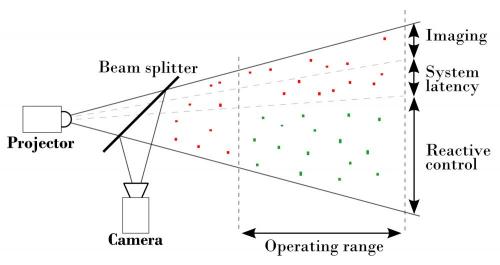
Computer science professor Srinivasa Narasimhan, whose research focuses on computer vision and computer graphics at Carnegie Mellon, wanted to see if he and his team could stream light in between the drops. Their answer consists of a co-located imaging 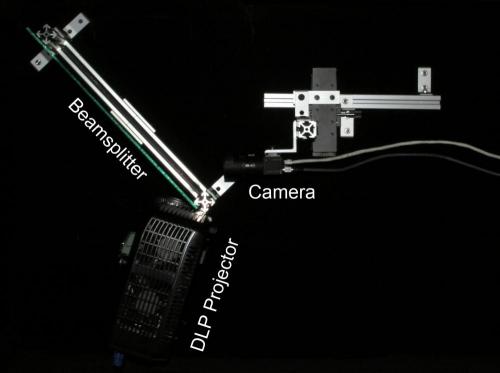 and illumination system– camera, projector, and beamsplitter. The idea of the design is to integrate an imager and processing unit with a light source. The beamsplitter (50/50) permits optically co-locating the camera and projector to eliminate the need for stereo reconstruction, according to team site comments about the project, reducing computations and increasing system speed.
The camera images the precipitation at the top of the field of view. The processor can tell where the drops are headed and sends a signal to the headlights, which make their adjustments and react to dis-illuminate the particles. The entire action, starting from capture to reaction, takes about 13 ms. (The system runs at 120 Hz. The camera uses a 5 ms exposure time and the system has a total latency of 13 ms.)