
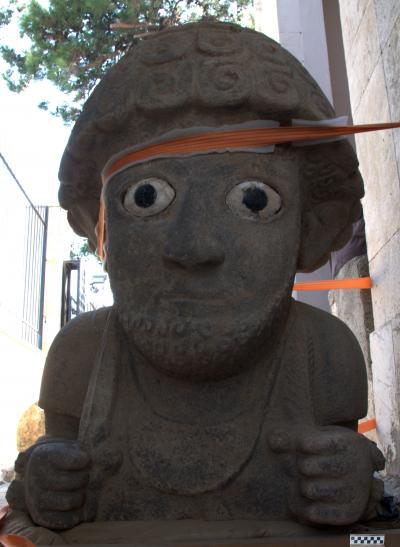
 An international team of archaeologists recently unearthed a colossal human structure along with an ornately decorated semi-circular column in southeastern Turkey.
Both pieces were originally part of a monumental gate complex that provided access to the upper citadel of Kunulua, capital of the Neo-Hittite Kingdom of Patina (ca. 1000-738 BC).
“These newly discovered Tayinat sculptures are the product of a vibrant local Neo-Hittite sculptural tradition,” explained Professor Tim Harrison of the University of Toronto.
“They provide a vivid glimpse into the innovative character and sophistication of the Iron Age cultures that emerged in the eastern Mediterranean following the collapse of the great imperial powers of the Bronze Age at the end of the second millennium BC.”
According to Harrison, the head and torso of the human figure, intact to just above its waist, stands approximately 1.5 meters in height, suggesting a total body length of 3.5 to four meters.
As can be seen in the photo above, the figure’s face is bearded, with preserved inlaid eyes made of white and black stone, while its hair has been styled in an elaborate series of curls aligned in linear rows.
Both arms are extended forward from the elbow, each with two arm bracelets decorated with lion heads. The figure’s right hand holds a spear, and in its left is a shaft of wheat. A crescent-shaped pectoral adorns its chest.
The second sculpture can best be described as a large semi-circular column base, approximately one meter in height and 90 centimeters in diameter, lying on its side next to the human figure.
A winged bull is carved on the front of the column and it is flanked by a sphinx on its left.
Interestingly enough, the right side of the column is flat and undecorated, suggesting that it was originally sculpted to stand against a wall.
“The two pieces appear to have been ritually buried in the paved stone surface of the central passageway through the Tayinat gate complex,” said Harrison.
“The complex would have provided a monumental ceremonial approach to the upper citadel of the royal city. Tayinat, a large low-lying mound, is located 35 kilometers east of Antakya (ancient Antioch) along the Antakya-Aleppo road.”
The presence of colossal human statues, often astride lions or sphinxes, in the citadel gateways of the Neo-Hittite royal cities of Iron Age Syro-Anatolia continued a Bronze Age Hittite tradition that accentuated their symbolic role as boundary zones, with the king acting as the divinely appointed guardian or gate keeper of the community.