
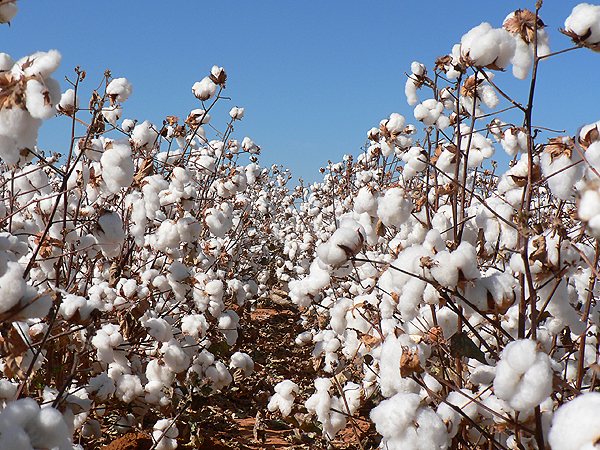
 “Contemporary crops such as Texas cotton are like finely tuned racing machines—they need high quality parts to perform optimally,” said Dr. David Stelly, AgriLife Research cotton geneticist in College Station. “And they constantly need new ones to replace ones that are no longer functional, as well as those that are still effective but no longer at the cutting edge of competition.”
Stelly said his role in the AgriLife Research cotton breeding program is to infuse new genes and gene combinations into the genetics and breeding research arena, “so that we can utilize natural genetic resources to help meet the many challenges breeding programs face.” Transferring genes into a cultivated crop from a wild species “is like swimming upstream, one is fighting all sorts of biological and genetic barriers,” he said. For years, he and his long-time research assistant, Dwaine Raska, have been transferring the alien genes by a special breeding process called “chromosome substitution.” “Using chromosome substitution, we can target one pair of cultivated cotton chromosomes at a time, and replace it with the corresponding pair of chromosomes from a wild species chosen as the donor.
On average, each substitution replaces about 2,000 cotton genes with donor genes,” Stelly said. Having already developed chromosome substitution lines for many chromosomes from three donor species, Stelly is working in collaboration with a former graduate student, Dr. Sukumar Saha, now with the U.S. Department of Agriculture-Agricultural Research Service unit at Mississippi State University, and his associates, to document their effects on cotton plant and fiber improvement. Stelly noted that the chromosome substitution breeding and research was made possible only because of teamwork among researchers and research supporters, especially AgriLife Research, the Texas State Support Committee, Cotton Inc., the Texas Department of Agriculture’s Food and Fiber Research Commission and the Agricultural Research Service. To significantly advance the cotton industry’s “racing machines,” breeders must shop around to find the best parts, and figure out how to optimize their contributions to performance, he said.