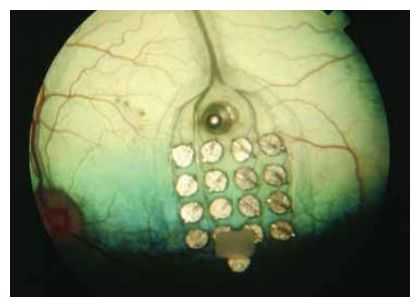
 The technology is a modification of a previous device, Argus II developed by Second Sight, which has been implanted on 50 patients, many of whom can now see colors, shapes, and movements. The complicated device uses a camera attached to a pair of glasses, a small processor to convert the signal of the camera into electrical stimulation, and a microchip with electrodes attached directly to the person’s retina.
The technology, used primarily for patients with retinal pigmentosis which causes patients to lose the use of their retina but to still have working neurons, can take up to 10 seconds to convert a single letter and minutes to read a single word, and can only be used with words that are printed in a large font and held up close to a person’s face. Street signs, for example, cannot be read. The new technology, a modification of the Argus II, should take just seconds to read words, by contrast.
“In this clinical test with a single blind patient, we bypassed the camera that is the usual input for the implant and directly stimulated the retina. Instead of feeling the Braille on the tips of his fingers, the patient could see the patterns we projected and then read individual letters in less than a second with up to 89% accuracy,” lead author of the paper Thomas Lauritzen said in a press release.
The device attaches 60 electrodes directly to a person’s retina in order to stimulate the nerve cells directly. In a trial conducted on a single patient who already used the Argus II device, the person was able to correctly read Braille letters up to 89 percent of the time, and most of the inaccuracy appeared when the participant misread a single letter. The user was able to read one word a second.
The patient was able to read eight of ten two-letter words, six of ten three-letter words, and seven of ten four-letter words, according to the Telegraph. Researchers believe that it will be easier to read longer words because misreading a single letter is less confusing for words with more letters.
Because fluent Braille readers can read 125 to 200 words per minute, the system is not intended to displace reading Braille traditionally. Instead, it is meant for reading words that do not have Braille translations, like street signs and other words in public places.
Makers of the device believe that it can help up to 65,000 people with retinal pigmentosis and similar conditions in Europe and the United States.
The study was published in the journal Frontiers in Neuroprosthetics .
( via medicaldaily.com )