
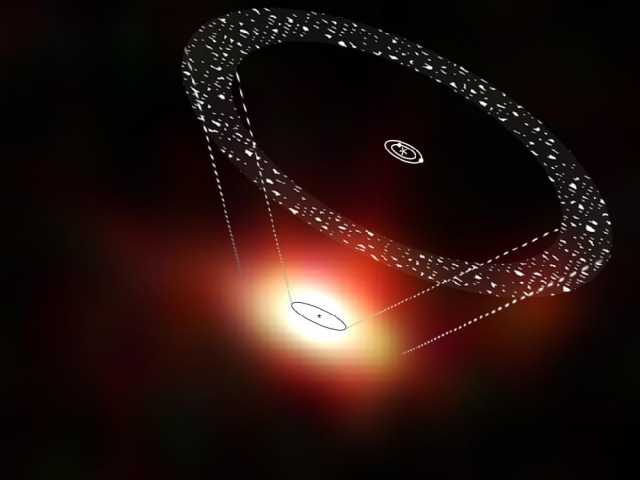
Peeping into the vastness of our galaxy, NASA reported that the Herschel space telescope of the European Space Agency (ESA) took images of vast comet belts surrounding two planetary systems. “Herschel continues to reveal surprising information about the strange configuration of solar systems in the Milky Way,” said NASA Herschel Project Scientist Paul Goldsmith.
The Herschel space telescope, officially named the Herschel Space Observatory, is known to have the largest single mirror for a space telescope at 3.5 meters in diameter. It can “collect long wavelength radiation from some of the the coldest and most distant objects in the Universe,” according to the ESA. It was launched in 2009 and its mission is expected to end by 2013.
NASA also contributed to study for this mission. The Herschel Project Office is located at NASA’s Jet Propulsion Laboratory in Pasadena, California, USA.
The solar systems found, namely GJ 581 and 61 Vir, could host Earth-to-Neptune-mass planets, but they’re filled with vast amounts of cometary debris, according to the NASA report.
“Herschel detected the signatures of cold dust at minus 200 degrees Celsius (minus 330 degrees Fahrenheit), in quantities that mean these systems must have at least 10 times more comets than in our own solar system’s Kuiper Belt,” NASA reported.
Kuiper Belt is Pluto’s official address, located billions of kilometers from our sun. It is a disc-shaped region composed of icy objects, such as ice dwarfs and debris. Located beyond Neptune’s orbit, this is believed to be the home of comets in our solar system.
GJ 581 also known as Gliese 581is a red dwarf star, 22 light years away from Earth. It can be located in the constellation we know as Libra. According to previous observation, GJ 581 may be host to at least three or four planets, including one that resides within the “goldilocks zone” or habitable zone.
( via gmanetwork.com)