
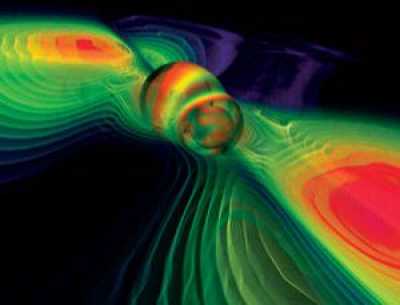
 TAKE the pulse of the universe, and its invisible wrinkles become visible. The first direct evidence of Einstein’s gravitational waves, may already exist in records of light pulses from rapidly spinning dead stars.
Crucially, we may uncover those waves as early as 2013. New research suggests that we’ve underestimated the rate at which black holes merge, and how that changes the light from pulsars.
Gravitational waves are produced by massive, accelerating objects, such as two black holes spinning towards each other (see diagram). The heavier the black holes are, and the faster they’re moving, the more powerful those waves. As they move, the waves stretch and squash space-time like the folds of an accordion. Measuring the waves would be a powerful test of general relativity, and would offer a new wavelength for probing the universe.
But finding traces of the waves is a big challenge, in part because we haven’t had the right tools. A proposed space-based detector was cancelled due to lack of funds, and our best Earth-based detector, LIGO, is closed until 2014 for a major upgrade. Once it is running, LIGO may need another four to five years to collect enough data.
In the meantime, wave hunters have been watching for subtle changes in the timing of pulsars. These dense cores of dead stars sweep the sky with beams of radio waves ejected from their poles. If the beams point directly at Earth, the pulsars appear to blink at exceptionally regular intervals. But when a gravitational wave goes by, it distorts space-time so that the pulsar and Earth bounce towards or away from each other, changing the distance that the pulsar’s light has to travel and making its beat irregular.
Pulsar timing is most sensitive to the larger waves coming from supermassive black holes in the centres of merging galaxies. But galaxies are merging all the time, so the universe is too noisy for a lone pulsar to give a definitive signal, says Sean McWilliams of Princeton University.
( via newscientist.com )