
 by John Timmer
The Polynesians’ epic voyages of exploration and colonization across the Pacific are one of humanity’s most impressive accomplishments (even if the local bird life wasn’t likely to have enjoyed it). Having most probably started in Taiwan, the explorers reached and settled on islands across most of the Pacific, as far north as Hawaii and as far south as New Zealand. And recent evidence shows that they also stopped in South America, where they stayed long enough to pick up food crops that eventually wound up distributed across the Pacific as well.
By the time they reached South America, however, several large and sophisticated civilizations had already developed along the west coast of that continent. This is in sharp contrast to the uninhabited islands that the Polynesians were used to colonizing, which raises questions about whether any of the voyagers were likely to have stayed in the newly discovered land. Genetic surveys of native populations in Peru and elsewhere have indicated that, if any did stick around, they didn’t make a significant contribution to the local gene pool.
But now, some researchers have found some Polynesian DNA in the remains of some Native Americans. Oddly, however, the remains are on the exact opposite side of the continent from where the Polynesians are likely to have landed. Even the researchers themselves are at a bit of a loss to explain it; after considering several possible causes, even the one they find most likely gets labelled as “fanciful.”
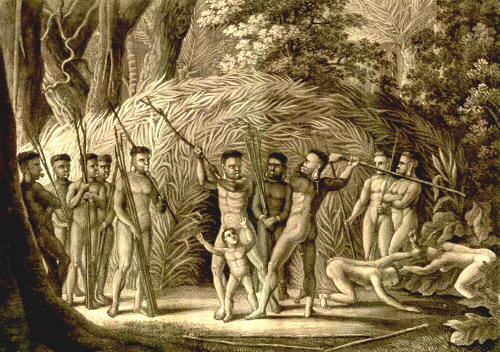
Although the interpretation is bewildering, the data is pretty clear-cut. The authors focused on a tribe that originally lived in the south-east of Brazil called the Botocudo. This group was violent and independent, and didn’t come under the control of the Portuguese colonial power. In 1808, the authorities essentially declared war against any group that fit this description. By the end of that century, the Botocudo had essentially ceased to exist as a distinctive ethnic group.
The remains of several Botocudo individuals, however, were preserved in museums, and the authors obtained DNA from over a dozen of them. That DNA was used to study parts of the mitochondrial genome, which is inherited exclusively through female lineages. Because it’s relatively easy to obtain and sequence, mitochondrial DNA has been used for a variety of studies of human evolution, and there’s a wealth of data available on the variations associated with different populations.
A dozen of these samples produced the sorts of sequences you’d typically see in Native American populations. But two others have a set of distinctive changes that, to date, have only been found in populations associated with Polynesian cultures.
So, how to explain this? The authors consider a number of possibilities. One is based on the fact that both Polynesians and Native Americans are originally derived from Asian populations. Thus, it’s possible that the ancestors of both these people shared a variant that has either gone extinct on the Asian mainland, or has just escaped the reach of our current sequencing efforts. However, all indications are that some of the changes we associate with Polynesians appear to be recent, and likely occurred after the population was on Taiwan. So, the authors consider that prospect unlikely.
The next possibility they consider is that the DNA arrived with the Polynesian voyagers themselves, which might seem plausible except for the fact that there’s an entire continent’s worth of individuals in between who, to date, seem to have no hint of Polynesian DNA. Plus some forbidding geography. “There still would remain the need to explain how these migrants crossed the Andes and ended up in Minas Gerais, Brazil,” the authors muse. “We feel that such a scenario is too unlikely to be seriously entertained.”
So, what’s left? The best of a bad bunch of explanations. Towards the end of the African slave trade, Britain’s ban on slavery led it to interdict vessels along the west coast of Africa. That shifted some of the trade to elsewhere, including Madagascar. That island was also settled by Polynesians, and about 20 percent of its population appears to carry DNA variants consistent with the Brazilian find. Once brought to Brazil, there were a few decades in which these individuals could have been kidnapped by and assimilated into the Botocudo (possibly producing offspring) before the tribe was exterminated. The authors helpfully note that a kidnapping of this sort was the subject of an 1870 opera by a Brazilian composer.