
By Brian Bennett
LA-Times
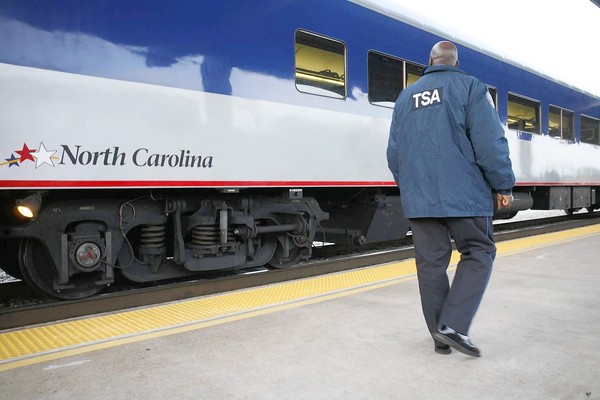
Rick Vetter was rushing to board the Amtrak train in Charlotte, N.C., on a recent Sunday afternoon when a canine officer suddenly blocked the way.
Three federal air marshals in bulletproof vests and two officers trained to spot suspicious behavior watched closely as Seiko, a German shepherd, nosed Vetter’s trousers for chemical traces of a bomb. Radiation detectors carried by the marshals scanned the 57-year-old lawyer for concealed nuclear materials.
When Seiko indicated a scent, his handler, Julian Swaringen, asked Vetter whether he had pets at home in Garner, N.C. Two mutts, Vetter replied. “You can go ahead,” Swaringen said.
The Transportation Security Administration isn’t just in airports anymore. TSA teams are increasingly conducting searches and screenings at train stations, subways, ferry terminals and other mass transit locations around the country.
“We are not the Airport Security Administration,” said Ray Dineen, the air marshal in charge of the TSA office in Charlotte. “We take that transportation part seriously.”
The TSA’s 25 “viper” teams — for Visible Intermodal Prevention and Response — have run more than 9,300 unannounced checkpoints and other search operations in the last year. Department of Homeland Security officials have asked Congress for funding to add 12 more teams next year.
According to budget documents, the department spent $110 million in fiscal 2011 for “surface transportation security,” including the TSA’s viper program, and is asking for an additional $24 million next year. That compares with more than $5 billion for aviation security.
TSA officials say they have no proof that the roving viper teams have foiled any terrorist plots or thwarted any major threat to public safety. But they argue that the random nature of the searches and the presence of armed officers serve as a deterrent and bolster public confidence.
“We have to keep them [terrorists] on edge,” said Frank Cilluffo, director of the Homeland Security Policy Institute at George Washington University in Washington. “We’re not going to have a permanent presence everywhere.”
U.S. officials note that digital files recovered from Osama bin Laden’s compound in Pakistan after he was killed by U.S. Navy SEALs in May included evidence that the Al Qaeda leader had considered an attack on U.S. railways in February 2010. Over the last decade, deadly bombings have hit subways or trains in Moscow; Mumbai, India; Madrid; and London.
But critics say that without a clear threat, the TSA checkpoints are merely political theater. Privacy advocates worry that the agency is stretching legal limits on the government’s right to search U.S. citizens without probable cause — and with no proof that the scattershot checkpoints help prevent attacks.
“It’s a great way to make the public think you are doing something,” said Fred H. Cate, a professor at the Indiana University Maurer School of Law, who writes on privacy and security. “It’s a little like saying, ‘If we start throwing things up in the air, will they hit terrorists?’ ”
Such criticism is nothing new to the TSA.
The agency came under fresh fire this month when three elderly women with medical devices complained that TSA agents had strip-searched them in separate incidents at John F. Kennedy International Airport. Lenore Zimmerman, 84, said she was ordered to pull down her pants after she refused to pass through a full body scanner because she was afraid the machine would interfere with her heart defibrillator.
TSA officials denied the women were strip-searched, but they announced plans to create a toll-free telephone number for passengers with medical conditions who require assistance in airport screening lines. TSA officials said they also are considering a proposal by Sen. Charles E. Schumer (D-N.Y.) to designate a passengers advocate at every airport.
The TSA’s viper program hasn’t drawn that kind of attention, although it is increasingly active.
In Tennessee in October, a viper team used radiation monitors and explosive-trace detectors to help state police inspect trucks at highway weigh stations throughout the state. Last month in Orlando, Fla., a team set up metal detectors at a Greyhound bus station and tested passengers’ bags for explosive residue.