
 By Sebastian Anthony
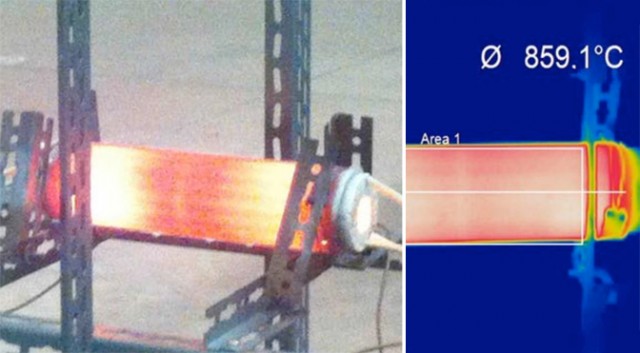
Against all probability, a device that purports to use cold fusion to generate vast amounts of power has been verified by a panel of independent scientists. The research paper, which hasn’t yet undergone peer review, seems to confirm both the existence of cold fusion, and its potency: The cold fusion device being tested has roughly 10,000 times the energy density and 1,000 times the power density of gasoline. Even allowing for a massively conservative margin of error, the scientists say that the cold fusion device they tested is 10 times more powerful than gasoline — which is currently the best fuel readily available to mankind.
The device being tested, which is called the Energy Catalyzer (E-Cat for short), was created by Andrea Rossi. Rossi has been claiming for the past two years that he had finally cracked cold fusion, but much to the chagrin of the scientific community he hasn’t allowed anyone to independently analyze the device — until now. While it sounds like the scientists had a fairly free rein while testing the E-Cat, we should stress that they still don’t know exactly what’s going on inside the sealed steel cylinder reactor. Still, the seven scientists, all from good European universities, obviously felt confident enough with their findings to publish the research paper.
As for what’s happening inside the cold fusion reactor, Andrea Rossi and his colleague Sergio Focardi have previously said their device works by infusing hydrogen into nickel, transmuting the nickel into copper and releasing a large amount of heat. While Rossi hasn’t provided much in the way of details — he’s a very secretive man, it seems — we can infer some knowledge from NASA’s own research into cold fusion. Basically, hydrogen ions (single protons) are sucked into a nickel lattice (pictured right); the nickel’s electrons are forced into the hydrogen to produce neutrons; the nickel nuclei absorb these neutrons; the neutrons are stripped of their electrons to become protons; and thus the nickel goes up in atomic number from 28 to 29, becoming copper.
This process, like the “conventional” fusion of hydrogen atoms into helium, produces a lot of heat. (See: 500MW from half a gram of hydrogen: The hunt for fusion power heats up.) The main difference, though, is that the cold fusion process (also known as LENR, or low energy nuclear reaction) produces very slow moving neutrons which don’t create ionizing radiation or radioactive waste. Real fusion, on the other hand, produces fast neutrons that decimate everything in their path. In short, LENR is fairly safe — safe enough that NASA dreams of one day putting a cold fusion reactor in every home, car, and plane. Nickel and hydrogen, incidentally, are much cheaper and cleaner fuels than gasoline.