
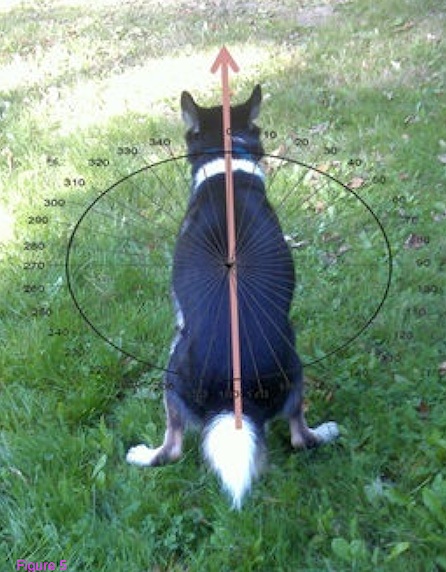
 Several mammalian species spontaneously align their body axis with respect to the Earth’s magnetic field (MF) lines in diverse behavioral contexts. Magnetic alignment is a suitable paradigm to scan for the occurrence of magnetosensitivity across animal taxa with the heuristic potential to contribute to the understanding of the mechanism of magnetoreception and identify further functions of magnetosensation apart from navigation. With this in mind we searched for signs of magnetic alignment in dogs. We measured the direction of the body axis in 70 dogs of 37 breeds during defecation (1,893 observations) and urination (5,582 observations) over a two-year period. After complete sampling, we sorted the data according to the geomagnetic conditions prevailing during the respective sampling periods. Relative declination and intensity changes of the MF during the respective dog walks were calculated from daily magnetograms. Directional preferences of dogs under different MF conditions were analyzed and tested by means of circular statistics.
Dogs preferred to excrete with the body being aligned along the North-south axis under calm MF conditions. This directional behavior was abolished under Unstable MF. The best predictor of the behavioral switch was the rate of change in declination, i.e., polar orientation of the MF.
Conclusions
It is for the first time that (a) magnetic sensitivity was proved in dogs, (b) a measurable, predictable behavioral reaction upon natural MF fluctuations could be unambiguously proven in a mammal, and (c) high sensitivity to small changes in polarity, rather than in intensity, of MF was identified as biologically meaningful. Our findings open new horizons in magnetoreception research. Since the MF is calm in only about 20 % of the daylight period, our findings might provide an explanation why many magnetoreception experiments were hardly replicable and why directional values of records in diverse observations are frequently compromised by scatter.