
 By Rachel Nuwer
Nearly 30 years have passed since the Chernobyl plant exploded and caused an unprecedented nuclear disaster. The effects of that catastrophe, however, are still felt today. Although no people live in the extensive exclusion zones around the epicenter, animals and plants still show signs of radiation poisoning.
Birds around Chernobyl have significantly smaller brains that those living in non-radiation poisoned areas; trees there grow slower; and fewer spiders and insects—including bees, butterflies and grasshoppers—live there. Additionally, game animals such as wild boar caught outside of the exclusion zone—including some bagged as far away as Germany—continue to show abnormal and dangerous levels of radiation.
However, there are even more fundamental issues going on in the environment. According to a new study published in Oecologia, decomposers—organisms such as microbes, fungi and some types of insects that drive the process of decay—have also suffered from the contamination. These creatures are responsible for an essential component of any ecosystem: recycling organic matter back into the soil. Issues with such a basic-level process, the authors of the study think, could have compounding effects for the entire ecosystem.
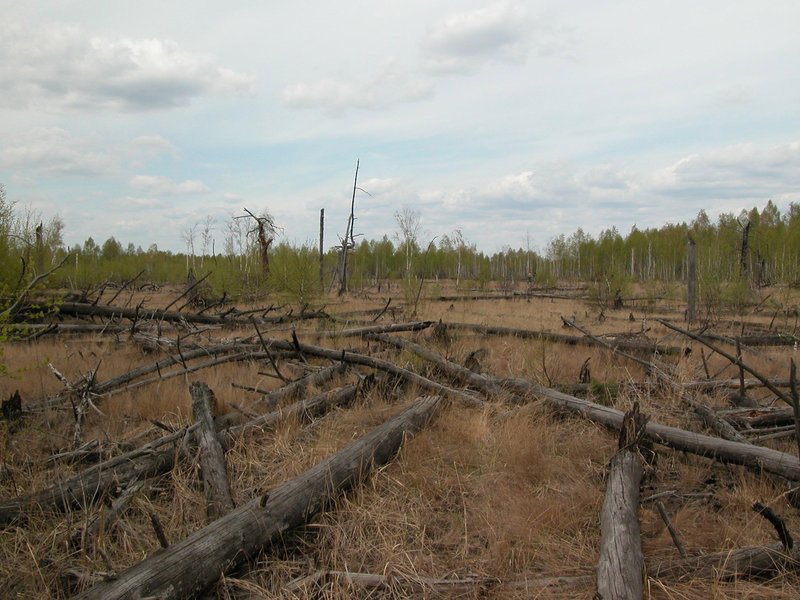
The team decided to investigate this question in part because of a peculiar field observation. “We have conducted research in Chernobyl since 1991 and have noticed a significant accumulation of litter over time,” the write. Moreover, trees in the infamous Red Forest—an area where all of the pine trees turned a reddish color and then died shortly after the accident—did not seem to be decaying, even 15 to 20 years after the meltdown.
“Apart from a few ants, the dead tree trunks were largely unscathed when we first encountered them,” says Timothy Mousseau, a biologist at the University of South Carolina, Columbia, and lead author of the study. “It was striking, given that in the forests where I live, a fallen tree is mostly sawdust after a decade of lying on the ground.”
Wondering whether that seeming increase in dead leaves on the forest floor and those petrified-looking pine trees were indicative of something larger, Mousseau and his colleagues decided to run some field tests. When they measured leaf litter in different parts of the exclusion zones, they found that the litter layer itself was two to three times thicker in the “hottest” areas of Chernobyl, where radiation poisoning was most intense. But this wasn’t enough to prove that radiation was responsible for this difference.
To confirm their hunch, they created around 600 small mesh bags and stuffed them each with leaves, collected at an uncontaminated site, from one of four different tree species: oak, maple, birch or pine. They took care to ensure that no insects were in the bags at first, and then lined half of them with women’s pantyhose to keep insects from getting in from the outside, unlike the wider mesh-only versions.
Like a decomposer Easter egg hunt, they then scattered the bags in numerous locations throughout the exclusion zone, all of which experienced varying degrees of radiation contamination (including no contamination at all). They left the bags and waited for nearly a year—normally, an ample amount of time for microbes, fungi and insects to make short work of dead organic material, and the pantyhose-lined bags could help them assess whether insects or microbes were mainly responsible for breaking down the leaves.
The results were telling. In the areas with no radiation, 70 to 90 percent of the leaves were gone after a year. But in places where more radiation was present, the leaves retained around 60 percent of their original weight.