
 By Dahr Jamail
“The fishermen have never seen anything like this,” Dr Jim Cowan told Al Jazeera. “And in my 20 years working on red snapper, looking at somewhere between 20 and 30,000 fish, I’ve never seen anything like this either.”
Dr Cowan, with Louisiana State University’s Department of Oceanography and Coastal Sciences started hearing about fish with sores and lesions from fishermen in November 2010.
Cowan’s findings replicate those of others living along vast areas of the Gulf Coast that have been impacted by BP’s oil and dispersants.
Gulf of Mexico fishermen, scientists and seafood processors have told Al Jazeera they are finding disturbing numbers of mutated shrimp, crab and fish that they believe are deformed by chemicals released during BP’s 2010 oil disaster.
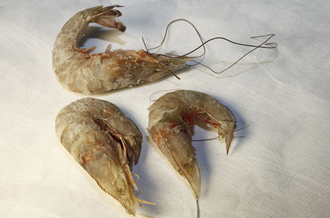
Along with collapsing fisheries, signs of malignant impact on the regional ecosystem are ominous: horribly mutated shrimp, fish with oozing sores, underdeveloped blue crabs lacking claws, eyeless crabs and shrimp – and interviewees’ fingers point towards BP’s oil pollution disaster as being the cause.
Eyeless shrimp
Tracy Kuhns and her husband Mike Roberts, commercial fishers from Barataria, Louisiana, are finding eyeless shrimp.
“At the height of the last white shrimp season, in September, one of our friends caught 400 pounds of these,” Kuhns told Al Jazeera while showing a sample of the eyeless shrimp.
According to Kuhns, at least 50 per cent of the shrimp caught in that period in Barataria Bay, a popular shrimping area that was heavily impacted by BP’s oil and dispersants, were eyeless. Kuhns added: “Disturbingly, not only do the shrimp lack eyes, they even lack eye sockets.”
“Some shrimpers are catching these out in the open Gulf [of Mexico],” she added, “They are also catching them in Alabama and Mississippi. We are also finding eyeless crabs, crabs with their shells soft instead of hard, full grown crabs that are one-fifth their normal size, clawless crabs, and crabs with shells that don’t have their usual spikes … they look like they’ve been burned off by chemicals.”
On April 20, 2010, BP’s Deepwater Horizon oilrig exploded, and began the release of at least 4.9 million barrels of oil. BP then used at least 1.9 million gallons of toxic Corexit dispersants to sink the oil.
Keath Ladner, a third generation seafood processor in Hancock County, Mississippi, is also disturbed by what he is seeing.
“I’ve seen the brown shrimp catch drop by two-thirds, and so far the white shrimp have been wiped out,” Ladner told Al Jazeera. “The shrimp are immune compromised. We are finding shrimp with tumors on their heads, and are seeing this everyday.”
While on a shrimp boat in Mobile Bay with Sidney Schwartz, the fourth-generation fisherman said that he had seen shrimp with defects on their gills, and “their shells missing around their gills and head”.
“We’ve fished here all our lives and have never seen anything like this,” he added.
Ladner has also seen crates of blue crabs, all of which were lacking at least one of their claws.
Darla Rooks, a lifelong fisherperson from Port Sulfur, Louisiana, told Al Jazeera she is finding crabs “with holes in their shells, shells with all the points burned off so all the spikes on their shells and claws are gone, misshapen shells, and crabs that are dying from within … they are still alive, but you open them up and they smell like they’ve been dead for a week”.