
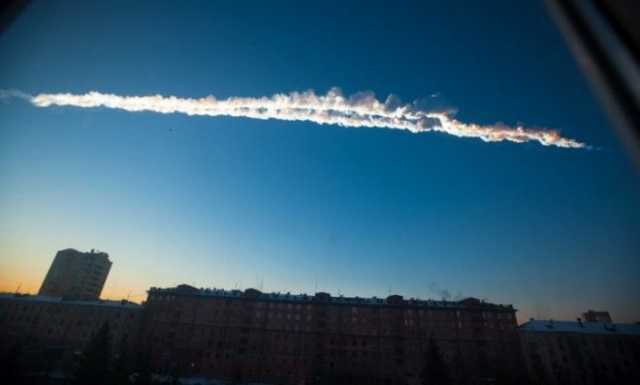
 A scientific team from Colombia was able to trace back the explosive space rock’s origins using “simple trigonometry.”
It’s been nearly two weeks since a blazing meteor suddenly appeared over Russia’s Ural region, and exploded seconds later over the city of Chelyabinsk. The destruction it caused is well documented: $33 million in estimated damage, 1,500 injured, and zero fatalities – amazing, considering the fireball detonated with 30 times the force of the atomic bomb dropped on Hiroshima.
But where in heaven’s name did the the thing come from to begin with?
Poring over crowd-sourced footage, researchers Jorge Zuluaga and Ignacio Ferrin from the University of Antioquia in Medellin, Colombia, were able to use “simple trigonometry to calculate the height, speed, and position of the rock as it fell to Earth,” says BBC News. More importantly, the duo was able to find out where Russia’s most famous meteor was likely born.
Using astronomy software developed by the U.S. Naval Observatory, Zuluaga and Ferrin gathered enough data to trace the meteoroid’s origins in outer space. The information included the meteor’s relative angle to the horizon, the shadows it cast, and video timestamps of the rock’s screaming descent.
Based on its trajectory and speed – zipping through the atmosphere at an estimated rate of 13 to 19 kilometers per second – the Russian meteor appears to have originated from the Apollo family of asteroids, which are “well-known near-Earth asteroids that cross the orbit of Earth,” says Discovery News: Around 5,200 Apollo asteroids are currently known, the largest being 1866 Sisyphus – a 10 kilometer-wide monster that was discovered in 1972. Large Apollos are identified as being a significant risk to our planet, so the Chelyabinsk meteoroid acted like an Apollo warning shot. According to Popular Science, the asteroid likely “spent about 4.5 billion years cruising around the solar system before its fiery arrival in Earth’s atmosphere.” At an estimated 10,000 tons, it was only a little larger than your average asteroid – at least before Earth’s atmosphere caused much of it to burn up.
Dr. Stephen Lowry from the University of Kent, who wasn’t involved in the study, says he agrees with Zuluaga and Ferrin’s analysis. “It certainly looks like it was a member of the Apollo class of asteroids,” Lowry told BBC News. “Its elliptical, low inclination orbit, indicates a solar system origin, most likely from the asteroid belt between Mars and Jupiter.”
( via theweek.com )