
 By SINDYA N. BHANOO
NY Times
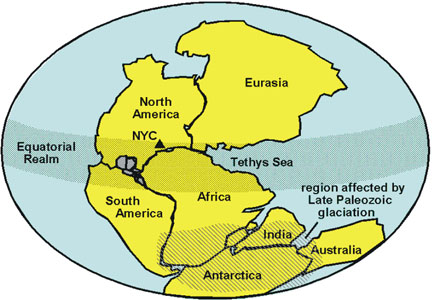
Geologists have long predicted that North and South America will eventually fuse together and merge with Asia, forming a new supercontinent along the lines of the ancient Pangea — the precursor to today’s great land masses, which separated about 200 million years ago.
In the past, researchers had guessed that the new continent, often called Amasia, would form either in the same location as Pangea, closing over the Atlantic near present-day Africa, or 180 degrees away, on the other side of the world.
But a new study predicts that Amasia will form over the Arctic Ocean.
“The fusion of North and South America together will close the Caribbean Sea and meet Eurasia at the present-day North Pole,” said Ross Nelson Mitchell, a geologist at Yale University, who worked on the study as part of his doctoral research.
“And Australia is moving north, and would probably snuggle to join Asia somewhere between India and Japan,” he added.
Mr. Mitchell and colleagues from Yale, who discuss their theory in the current issue of the journal Nature, modeled the movement of supercontinents of the past using paleomagnetic data, a measurement of the force between the earth’s rocks.
Once each supercontinent is assembled, it undergoes back-and-forth rotations about a stable axis on the Equator, Mr. Mitchell said. This motion is called true polar wander. Using this, the researchers determined the center of each of the previous supercontinents — Pangea (often spelled Pangaea), Rodinia and Nuna.
There was a clear pattern. In each case, the centers of the supercontinents were separated by 90 degrees.