
By Peter Walker
Guardian UK
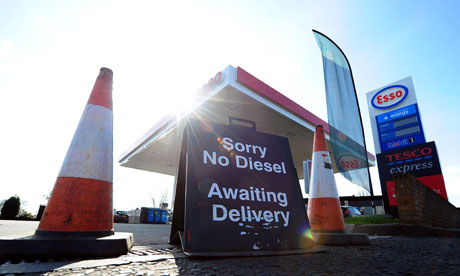
6.41pm: The Petrol Retailers Association, which represents about 5,500 garages, has blamed the government for causing panic buying.
“This is exactly what we didn’t want – people panic-buying. Deliveries are still being made to garages and we are advising people to continue with their normal buying habits,” a spokesman told PA.
A motorist in Ilkley, Yorkshire, was asked to leave a garage forecourt after snatching the pump out of the hand of a female driver, an eyewitness told the news agency.
One van driver in Leeds said he had been waiting 30 minutes to get fuel while in Harrogate a forecourt on the outskirts of the town had run out of fuel by 11.30am.
Retail store Halfords reported “high” sales of fuel cans. Sales of all cans have soared by 225% compared with this time last year, with motorists buying in “the thousands”, while sales of jerry cans are up by more than 500%.
Firefighters were called to deal with a fuel spillage after a car was overfilled with petrol in Crawley, West Sussex.
4.40pm: Dan Milmo notes that the chances of a tanker drivers’ strike affecting the Easter getaway now appear fairly remote:
Strike laws mean that if tanker drivers want to disrupt Easter they need to call strikes by 5pm tomorrow. Under the 1992 Trade Union and Labour Relations Act, trade unions must give seven days’ notice before taking industrial action.
With the focus on getting talks underway with Acas, the conciliation service, a union source said the chances of Easter walkouts were increasingly unlikely. “The threat of an Easter strike is receding,” said the source.
It is understood that Unite and the hauliers still have differences over the agenda for the talks although there is hope that those will be ironed out in time for sit-down talks to begin on Monday.
4.32pm: My business desk colleague, Graeme Wearden, has been busy looking at the possible economic implications of this sudden rush to buy fuel:
It’s possible that the rise in fuel sales in the last few days could give enough of a boost to economic activity for Britain to avoid a double-dip recession. But it’s a complex question, and we may not know the full story for several months.
The Office for National Statistics confirmed to us that any increased spending on fuel would, in itself, equate to an increase in economic activity.
“Inevitably, this spending would feed through,” an ONS spokesman said. “Any activity that is above the usual would have an effect on overall output.”
Importantly, £1 of retail spending will usually makes a larger contribution to total economic activity. In the case of petrol, the ONS will also track the economic activity that took place when the crude oil was extracted and refined, and then transported to the petrol station. As the ONS spokesman puts it:
“All economic data feeds into the GDP number, so every transaction has a multiplying effect.”
Petrol sold today was extracted many weeks ago – but the multiplier effect could be significant, if suppliers try to respond to the current boost in sales by shipping more fuel to the forecourt.
The ONS won’t be drawn on the specific question of how today’s fuel panic might affect GDP data, and pointed out that sales made this week may simply be brought forward from next week. However, the current quarter ends at midnight Saturday/Sunday, so GDP in the current quarter, and the next, could both feel an impact.
So, onto the numbers. Yesterday, the ONS reported that UK GDP fell by 0.3% in the fourth quarter of 2011 to £352.42bn. This morning, the OECD estimated that GDP will fall by 0.1% in the current quarter. That would mean a technical recession (according to the definition of ‘two consecutive quarters of negative growth’ used in the UK). That 0.1% drop in GDP forecast by the OECD is equal to around £350m less economic activity.
How much extra petrol is being bought? If the AA’s estimate of an extra £32m of duty (see 3.03pm) is right, that sounds like around £45m of extra sales. If sales today are much higher (as appears likely), and that trend continues on Friday and Saturday, then we could possibly see enough extra activity to nudge the GDP by that magic 0.1%.
Incidentally, because GDP changes are rounded up or down to the nearest 0.1%, it’s possible that a smaller increase in output would be enough to ‘tip the scales’.