
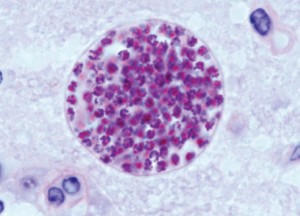
Imagining tiny creatures infiltrating human brains is creepy enough. But Marion Vittecoq knows she has been invaded. Her inner companions may be just hanging out — or they may be subtly changing her personality, manipulating her behavior or altering her risk of disease. Yet she doesn’t sound particularly upset.
Not once in the course of a phone conversation and many e-mails did Vittecoq recommend wearing tinfoil hats or mention mind control by the CIA, the United Nations or little green men beaming rays from the moons of Uranus. She studies the ecology of parasites, especially the one-celled Toxoplasma gondii, which coincidentally is the creature that has invaded her brain.
She doesn’t see it as an extra-ordinary intrusion. The parasite has wormed its way into an estimated one-third of people on the planet. In France, where Vittecoq works at both a CNRS national research lab in Montpellier and the Tour du Valat research center in Arles, nearly one-third to about one-half of adults carry hitchhiking T. gondii. CNRS research colleague Frédéric Thomas is also infected, and also doesn’t fret about it.
In the United States, almost one in four residents over the age of 12 has the infection. In other parts of the world, rates are as high as 95 percent. An unlucky minority of these infected people become quite ill. Most, however, don’t even know that their muscles and brains carry the parasite.
What exactly T. gondii is doing while it lurks in so many people is an important question for public health. It’s also an alluringly spooky question. “Where science meets science fiction” is how Michael Dickinson of the University of Washington in Seattle describes studies of parasites that hack into their hosts’ nervous systems. The Journal of Experimental Biology, where Dickinson serves as an editor, dedicated its Jan. 1 issue to this emerging field, dubbed “neuroparasitology.” In those pages and elsewhere, clues to T. gondii’s bizarre biology are emerging. And growing evidence suggests that the hidden parasite may have visible effects.
Studies comparing the infected and the noninfected raise the possibility that the parasite tweaks a person’s personality or ups the risk of suicide attempts, brain cancer and schizophrenia. Studies in people even report links between T. gondii and traffic accidents, greater odds of having sons than daughters, extra height and unusual opinions about the smell of urine.
If so much of what people do turns out to have a touch of parasite about it, then the notion of normal human behavior may have to change. What is “routine” for people might need to encompass not just the activities of a Homo sapiens by itself, but also the doings of Homo sapiens as a walking ecosystem where microbes and mammal intermingle.