
 Nearly 1,000 people were injured in Russia today when a meteor exploded somewhere over the Ural Mountains. But crazy cosmic phenomena are nothing new in the Ural range: 54 years ago this month, the northern part of the Urals played host to one of the most fascinating unsolved mysteries in the modern age.
On the surface, what’s become known as the Dyatlov Pass incident seems fairly explicable: Of a party of ten skiiers, nine perished in the middle of a high-difficulty trek in conditions that reached -30 degrees Celsius. But the details, which are mostly based on diaries of those involved as well as records from Soviet investigators, are chilling: On the night of February 2, 1959, members of the party apparently ripped their tent open from the inside, and wandered into the tundra wearing nothing but what they wore to bed.
Three weeks later, five bodies were found, some hundreds of meters down a slope from the original camp. It took two more months for investigators to find the other four bodies, which, curiously, were partially clothed in articles belonging to the earlier-discovered dead. Tests of those clothes found high levels of radiation. Despite that, and heavy internal trauma, including fractured skulls and broken ribs, suffered by some members of the party, Russian investigators reported they could not find evidence of foul play, and quickly shut the case.
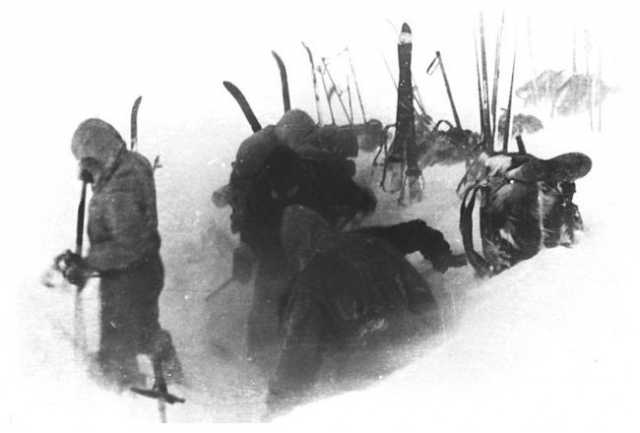
The group was made up of students and graduates of the Ural State Technical University, all of whom were experienced in backcountry expeditions. The trip, organized by 23 year old Igor Dyatlov, was meant to explore the slopes Otorten mountain in the nothern part of the Ural range, and started on January 28, 1959. Yury Yudin, the only member of the expedition to survive, got sick before the crew made it fully into the backcountry, and stayed behind at a village. The other nine trekked on, and according to photographs developed from rolls recovered by investigators, Dyatlov’s crew set up camp in the early evening of February 2 on the slopes of a mountain next to Ortoten.
That mountain is known to the local, indigenous Mansi tribe as Kholat Syakhl, which supposedly translates to “mountain of the dead,” although with a tale like this, I’d take something so perfectly creepy with a grain of salt. Still, the decision to camp on the mountain’s slope makes little sense. The group was reportedly only about a mile from the treeline, where they could have found at least a bit more shelter in the subzero conditions. They didn’t appear to be strapped for time, and setting up camp on the face of a mountain rather than within a nearby forest is questionable, although not indefensible.
“Dyatlov probably did not want to lose the distance they had covered, or he decided to practice camping on the mountain slope,” Yudin told the St. Petersburg Times in 2008.
( via motherboard.vice.com )