
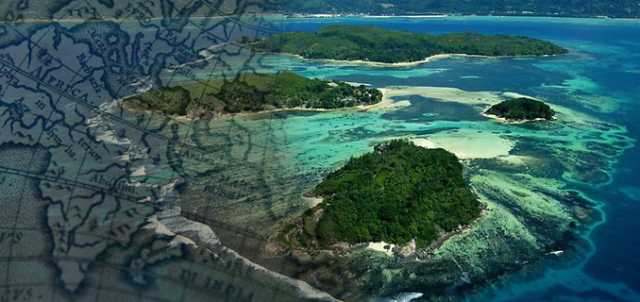
It isn’t quite Atlantis, but scientists from Norway, Germany and Britain have found what they say is a lost continent that they’ve named Mauritia at the bottom of the Indian Ocean.
“We found zircons that we extracted from the beach sands, and these are something you typically find in a continental crust,” Trond Torsvik a professor from the University of Norway told the BBC. “They are very old in age.”
The focus on zircons refers to the fact that most islands, except for very large ones such as Greenland, usually have surfaces that are much different than continents. Further, the bottom of the Ocean is quite different than the continental surface.
The zircons themselves are not especially notable, but the radiological age of the zircons found in the “Mauritia” landmass implies continental crust instead of Ocean floor.
The strip of continent, now at the bottom of the Indian Ocean, once connected Madagascar, the island archipelago of Seychelles and India. As tectonic movement shifted the land masses apart, the connective tissue of Mauritia was pushed to the bottom of the Ocean, where it was shredded and partially consumed by underwater volcanos.
“At the moment the Seychelles is a piece of granite, or continental crust, which is sitting practically in the middle of the Indian Ocean,” Professor Torsvik told the BBC. ”But once upon a time, it was sitting north of Madagascar. And what we are saying is that maybe this was much bigger, and there are many of these continental fragments that are spread around in the ocean.”
The land mass would have been part of the supercontinent of Rodinia, which existed between two billion and 85 million years ago. It did not exist as part of the later, better known, Pangea supercontinent.
It isn’t a sure thing that the continent exists, however. Geologist Jérôme Dyment, told National Geographic that he was unconvinced with the evidence.
“Extraordinary claims require extraordinary evidence, which are not given by the authors so far,” Dyment told the magazine. ”Finding zircons in sand is one thing, finding them within a rock is another one … Finding the enclave of deep rocks that, according to the author’s inference, bring them to the surface during an eruption would be much more convincing evidence.”
( via news.nationalpost.com )