
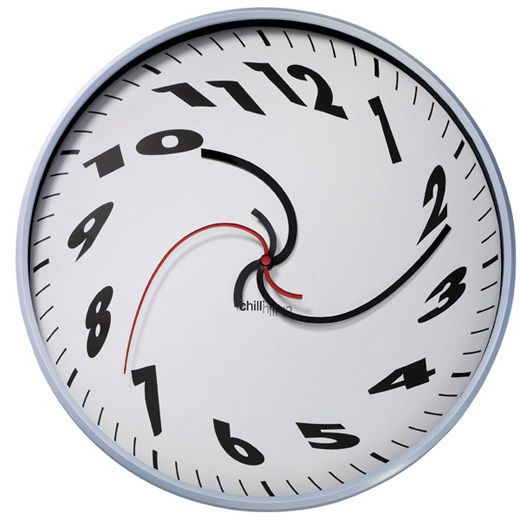
 The last minute of June 30, 2012 is destined to be 61 seconds long, for timekeepers are to add a “leap second” to compensate for the wibbly-wobbly movements of our world. The ever-so-brief halting of the second hand will compensate for a creeping divergence from solar time, meaning the period required for Earth to complete a day.
The planet takes just over 86,400 seconds for a 360-degree revolution. But it wobbles on its axis and is affected by the gravitational pull of the Sun and Moon and the ocean tides, all of which brake the rotation by a tiny sliver of a second. As a result, Earth gets out of step with International Atomic Time (TAI), which uses the pulsation of atoms to measure time to an accuracy of several billionths of a second.
To avoid solar time and TAI moving too far apart, the widely used indicator of Coordinated Universal Time (UTC) is adjusted every so often to give us the odd 86,401-second day. The adjustments began in 1972. Before then, time was measured exclusively by the position of the Sun or stars in relation to Earth, expressed in Greenwich Mean Time (GMT) or its successor UT1.
This will be the 25th intervention to add a “leap second” to UTC. “Today, time is constructed, defined and measured with atomic clocks that are infinitely more stable than astronomical time,” Noel Dimarcq, director of the SYRTE time-space reference system at the Paris Observatory told AFP.
“This allows us to ensure that everyone on Earth is on the exact same time.” TAI is kept by several hundred atomic clocks around the world, measuring fluctuations in the atom of the chemical element caesium that allows them to divide a single second into 10 billion smaller bits. With such precision, “only one (atomic) second is lost every 300 million years,” said Dimarcq.
Every time the discrepancy between TAI and UT1 becomes too big, the International Earth Rotation and Reference Systems Service (IERS) jumps into action and announces a “leap second” – usually several months in advance. The extra second is added to UTC, also known as Zulu time, only ever at midnight, either on a December 31 or a June 30.
Time-catching is as irregular as the Earth’s rotation itself. The last three adjustments were in 2008, 2005 and 1998. The year 1972 saw two additions, followed the next seven years by a second every year. The vast majority of the world’s seven billion people are likely to be blithely indifferent to Saturday’s change, except for a few who may note the curious fact that they will live a second longer. But among scientists, the issue is not without importance.
The leap second has long caused debate among member countries of the International Telecommunication Union (ITU), with some arguing for it to be abolished in favour of the exclusive use of atomic time. Every time a second is added, the world’s computers need to be manually adjusted, a costly practice that also boosts the risk of error.
High-precision systems such as satellites and some data networks will have to factor in the leap second or risk provoking a calculation catastrophe. For this reason, rocket launches are never scheduled for leap-second dates.