
 By Angela Bowman
Earlier yesterday morning, traders expected the USDA’s latest Crop Progress report to show a 3 to 5 percentage point drop for both corn and soybean condition ratings, and the USDA didn’t disappoint. Monday’s report showed that the nation’s corn crop has plummeted by 5 percentage points.
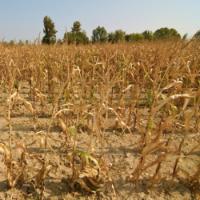
Nearly half of the nation’s corn fields are now rated in poor to very poor condition.
Corn: 45 percent in poor to very poor condition
The report showed that 86 percent of corn has now silked, which is well above last year’s report of 56 percent. Twenty-two percent of corn is now in the dough stage and 6 percent of corn has dented, compared to the five-year average of 9 and 2 percent.
Nationally, crop conditions stumbled again this week, falling by 5 percentage points:
| Very Poor | Poor | Fair | Good | Excellent | |
| This week | 21 | 24 | 29 | 23 | 3 |
| Last week | 16 | 22 | 31 | 27 | 4 |
| Last year | 5 | 9 | 24 | 46 | 16 |
This week marks the eighth consecutive report with falling crop conditions.
The graphic at right gives an animated look at the rate the crop conditions have dropped over the last 10 weeks. Click on the graphic to see the animation.
Though the drought conditions are now the most severe since the 1950s, many producers and experts are still comparing this crop to the 1988 drought, which cost U.S. agriculture $78 billion. Here is a look at how key states and the national average compare to the Crop Progress data from July 24, 1988:
U.S.
| Very Poor | Poor | Fair | Good | Excellent | |
| July 23, 2012 | 21 | 24 | 29 | 23 | 3 |
| July 24, 1988 | 13 | 32 | 35 | 18 | 2 |
Indiana:
| Very Poor | Poor | Fair | Good | Excellent | |
| July 23, 2012 | 38 | 33 | 22 | 6 | 1 |
| July 24, 1988 | 21 | 49 | 28 | 2 | 0 |
Kentucky:
| Very Poor | Poor | Fair | Good | Excellent | |
| July 23, 2012 | 43 | 34 | 17 | 5 | 1 |
| July 24, 1988 | 22 | 53 | 22 | 3 | 0 |
Missouri:
| Very Poor | Poor | Fair | Good | Excellent | |
| July 23, 2012 | 48 | 31 | 16 | 4 | 1 |
| July 24, 1988 | 22 | 49 | 23 | 6 | 0 |
Ohio:
| Very Poor | Poor | Fair | Good | Excellent | |
| July 23, 2012 | 21 | 31 | 33 | 14 | 1 |
| July 24, 1988 | 37 | 38 | 22 | 3 | 0 |
The USDA has already reduced its estimated yields for both corn and soybeans in a season that began as a potentially record corn crop as farmers planted the biggest area since 1937. A Reuters poll of 13 analysts have pegged the average estimated corn yield of 137.2 bushels per acre, down 6 percent from the USDA’s forecast of 146 bushels. The USDA dropped its yield estimate by an unprecedented 20 bushels per acre in its report on July 11.
With El Niño delayed until at least the third- or fourth- quarter of 2012, producers can only hope that the heat waves will ease and fronts push wetter conditions into the region. Read More.
Soybeans: Setting pods but baking
For soybeans, the news is just as grim. Though 36 percent of the soybeans have already set pods, compared to 16 percent last week, conditions continue to decline. This week soybeans fell by 3 percentage points, with 35 percent of soybeans in poor to very poor condition.
Here’s a look at the nation’s soybean crop:
| Very Poor | Poor | Fair | Good | Excellent | |
| This week | 13 | 22 | 34 | 27 | 4 |
| Last week | 10 | 20 | 36 | 30 | 4 |
| Last year | 3 | 8 | 27 | 49 | 13 |
The current weather pattern is causing some experts to worry, since especially important for the soybean crop.
“Historically, August is when the soy yield is determined, but because everything is early this year, we are seeing the buying interest show up earlier. We know we’ve lost corn yield, but we don’t know how much, “said Karl Setzer, an analyst at MaxYield Cooperative told Reuters.