
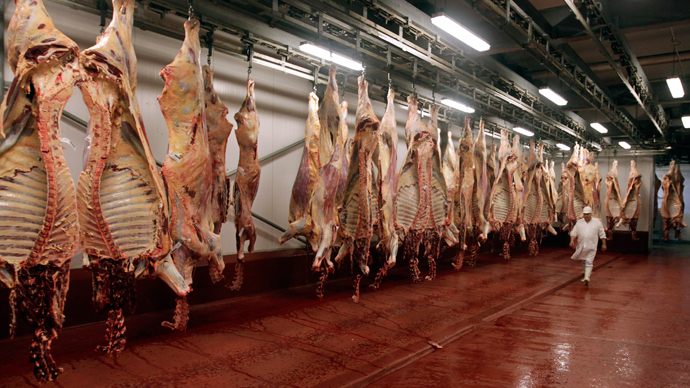
A meat inspection program which the US Department of Agriculture hopes to approve for all domestic pork plants has frequently allowed the production of contaminated meat at American and foreign plants where the approach has already been instituted.
Under the program, meat production facilities are allowed to have as much as 20 percent speedier processing lines, and companies can employ more of their own inspectors while having fewer in-house USDA inspectors.
These protocols are already allowed in five US hog plants as part of a pilot program that began in 1997 with the intention of allowing all pork plants nationwide to institute the program after a USDA safety analysis.
However, three of the pilot plants were found to be among the 10 worst offenders for domestic health and safety infractions, including failure to detect and remove fecal matter from meat, according to a report this spring by the USDA inspector general. Government inspectors eventually caught the violations at the end of processing lines, though federal procedure considers such late detection to be a violation of standards.
While nationwide consent for the pilot program is on hold, foreign red meat exporters to the US are allowed to follow similar procedures. In the last two years, plants following the new inspection guidelines in Canada and Australia were cited for a host of problems with exported meat, according to The Washington Post.
The five US plants were allowed in 1997 to begin the Hazard Analysis and Critical Control Point-based Inspection Models Project (HIMP), which granted the use of private inspectors and accelerated processing lines. The move was considered a significant victory for meat production companies looking to maximize profit and reduce regulatory strictures on inspection procedure. The government saw the new guidelines as potentially cost-saving for consumers.
The USDA said in 1997 that it would monitor the new guidelines at the five plants in expectation of offering them nationwide. But by this past spring, the USDA still had not evaluated the pilot program for its stated safety and health goals. The agency says it will have a complete report in March and hopes to make the case for 608 hog plants in the US.
Yet the USDA inspector general’s office has found that three of the five plants in the pilot program have garnered scores of health and safety violations. Auditors did not identify the five plants, nor could it determine whether the infractions could be attributed to the inspection system, since no official study had been done.
The auditors did say, however, that safety records at the three most troubled pilot plants are worse than those at hundreds of other US pork plants that use the traditional system, with slower processing lines and more government inspectors.
A separate report by the Government Accountability Office said the pilot program was too small to “provide reasonable assurance that any conclusions can apply more broadly to the universe of 608 hog plants in the United States” and that comparable data from pilot plants and traditional plants was needed to evaluate the new procedures.
Six USDA inspectors working in the pilot plants raised health concerns in interviews with The Washington Post. Several of them said that company and government workers are verbally abused and threatened for slowing down the faster processing lines or for complaining too much about safety procedures.
“We are no longer in charge of safety,” said one inspector. “That’s what the public needs to know.”
Several trade partners have received permission from the US to use HIMP-related safety and health procedures at processing plants in recent years. USDA auditors visited plants in Canada, Australia and New Zealand, and determined their systems were similar to the US pilot program.
Three beef plants in Canada that export to the US were allowed to use new guidelines starting in 2006. Since then, there have been occasional cases of tainted meat being rejected at the US border. The worst case of contaminated beef occurred around one year ago, leading to 18 reports of illness in Canada, although none were reported in the US.
In September 2012, a Canadian plant owned by XL Foods Inc. had to recall 8.8 million pounds of beef and beef products contaminated with E. coli. Around 2.5 million pounds of the tainted product went to the US market. A Canadian government-appointed independent review panel found the pace of the inspection system to be a contributing factor to the health infractions.
“If the line speed is too fast, workers would have little time to examine and trim off visible contamination from carcasses,” the panel wrote in a report. “Staff would also have insufficient time to properly sterilize their knives between trimmings.”
The panel also stated that the speed of processing lines made sanitizing carcasses for E. coli more difficult.
“If sprays are not properly applied to the carcass, they could serve to spread the contamination across a wider area,” the report said.
The Canadian plant is now owned by JBS USA, the largest beef exporter in North America.
Meanwhile, USDA officials have called Australia “the worst performer of all exporting countries.” After allowing the pilot program in Australian facilities in 2008, USDA officials began to take notice of tainted products at port-of-entry inspections.
In early 2012, USDA inspectors rejected “multiple” shipments of contaminated Australian meat, according to internal documents.
Australian food safety officials announced improved inspection protocols last summer, yet the USDA protested again in December saying the new guidelines weren’t “effective across the system.” The US agency said that meat with fecal matter and partly digested food from multiple plants using the new inspection system had arrived at US ports. Contaminated products included beef, mutton, and goat meat.
Since New Zealand plants were granted permission to use the new guidelines in 2011, no meat produced by the plants has been rejected at US ports due to contamination.