
 By Colin Barras
New-Scientist
And so it begins. For years, evolutionary biologists have predicted that new human species would start popping up in Asia as we begin to look closely at fossilised bones found there. A new analysis of bones from south-west China suggests there’s truth to the forecast.
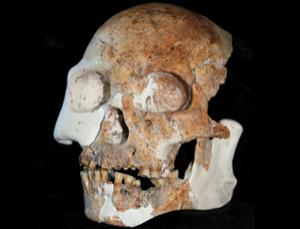
The distinctive skull (pictured, right) was unearthed in 1979 in Longlin cave, Guangxi Province, but has only now been fully analysed. It has thick bones, prominent brow ridges, a short flat face and lacks a typically human chin. “In short, it is anatomically unique among all members of the human evolutionary tree,” says Darren Curnoe at the University of New South Wales in Sydney, Australia.
The skull, he says, presents an unusual mosaic of primitive features like those seen in our ancestors hundreds of thousands of years ago, with some modern traits similar to living people.
What’s more, Curnoe and Ji Xueping of Yunnan University, China, have found more evidence of the new hominin at a second site – Malu cave in Yunnan Province. Curnoe has dubbed the new group the Red Deer Cave people because of their penchant for venison. “There is evidence that they cooked large deer in Malu cave,” he says.
Muddled tree
Exactly where the Red Deer Cave people belong in our family tree is unclear. Curnoe says they could be related to some of the earliest members of our species (Homo sapiens), which evolved in Africa around 200,000 years ago and then spread across Asia to reach China. He prefers the idea that they represent a new evolutionary line that evolved in East Asia in parallel with our species, just as Neanderthals did – primarily because they look very different to early African members of our species.
There are other possible interpretations. Chris Stringer at the Natural History Museum in London, says their distinctive primitive features might suggest they are related to the enigmatic Denisovan people, known from a 30,000 to 50,000-year-old finger bone and tooth found in a Siberian cave.
We know that the Denisovans were living in East Asia, and from a DNA analysis, that they mated with our direct ancestors. The Red Deer Cave people, says Stringer, could even be the product of that mating.
Long-standing people
Although we still do not know exactly where they came from, we do know that the Red Deer Cave people survived until relatively recently. Some of the newly described fossils are just 11,500 years old, suggesting that unlike Neanderthals they made it through the height of the last ice age.
They might not have been the only ancient humans to survive so late, saysMichael Petraglia at the University of Oxford. We already know of human skeletons with unusual archaic features in south Asia and India that are just 8000 years old.
The next step is to analyse DNA extracted from the Red Deer Cave bones, which will tell us more about their owner’s evolutionary history – whether they mated with any other hominins, for instance, and if they are truly a new species that evolved entirely in East Asia, as Curnoe believes, or are off-shoots of the Denisovan people.
Curnoe says an initial attempt to extract good DNA from the fossils failed. “We are doing more work now involving three of the world’s major ancient DNA laboratories,” he says. “We’ll just have to wait and see if we’re successful.”